Most buyers compare double cab pickups on payload and price. In Singapore, the number that moves your total cost most is neither — it is the classification on the registration. The Isuzu D-Max 4X4 Double Cab is listed by Isuzu Singapore under its Goods cum Passenger Vehicle range, not its Light Goods Vehicle range. That distinction runs through your Additional Registration Fee, your rebate at deregistration, and whether this platform is genuinely cheaper than a van for your crew.
Is the Isuzu D-Max double cab a car or a commercial vehicle?
Neither, strictly. Isuzu Singapore lists the D-Max 4X4 Double Cab Automatic under its Goods cum Passenger Vehicle line-up — a category built for vehicles that carry both people and cargo. It is not filed under the Light Goods Vehicle range that covers the N-Series lorries. The distinction is regulatory, not marketing.
A GPV occupies an awkward middle ground. It has a cargo bed like a goods vehicle and a rear passenger row like a car. Singapore's tax framework has to decide which one it is treated as, and the answer is not the one most buyers assume.
What does GPV classification actually mean for your business?
It means the vehicle is taxed closer to a passenger car than to a lorry. Goods-cum-passenger vehicles do not receive the concessionary treatment that pure goods vehicles get, because the rear seats make the vehicle useful for private transport. That is the trade-off for carrying a crew legally.
Operators who move between a van and a pickup on price alone often miss this. The pickup looks competitive on body price, then the registration cost lands and the gap widens considerably.
Why does GPV change what you pay in ARF?
Additional Registration Fee for pure heavy goods vehicles is levied at 5% of Open Market Value under LTA's commercial vehicle taxation framework. Goods-cum-passenger vehicles fall outside that concession and sit against the tiered schedule applied to passenger cars, which starts far higher and escalates with OMV.
On a vehicle with meaningful OMV, that difference is not a rounding error. It is frequently the single largest line separating a double cab from an equivalent panel van, and it does not appear on a specification sheet.
Which COE category does a double cab pickup fall under?
Category C covers goods vehicles and buses. Commercial vehicles above 1,600 kg unladen weight fall into this category under LTA classification. Confirm the registered category on the log card rather than assuming it, because classification on a dual-purpose vehicle is decided at registration, not by body shape.
Category C premiums move twice monthly through open bidding. As at August 2026 the Prevailing Quota Premium for Category C sits at S$92,599, following a Quota Premium of S$93,889 at the 22 July exercise. Verify the current figure on LTA OneMotoring before you commit — it resets on the 1st of each month.
What licence do you need to drive an Isuzu D-Max double cab?
It depends on registered unladen weight, not on the vehicle looking like a pickup. Singapore Police Force sets the Class 3 ceiling at 2,500 kg unladen weight; above that, Class 4 applies. Most diesel double cabs sit below that ceiling, but the registered figure is the only one that governs.
The unladen weight for the Singapore D-Max double cab is not published on Isuzu Singapore's line-up page. [VERIFY] — read it off the log card or request it in writing from the distributor before you assign a driver.
Why is unladen weight the number that decides your licence?
Because the licensing framework and the vehicle-classification framework measure different things. Licence class keys off unladen weight — the vehicle empty. Grant eligibility, road tax banding and heavy goods vehicle classification key off maximum laden weight — the vehicle plus its maximum permitted load.
The two move independently. A build can sit comfortably inside one threshold while crossing the other. Never infer a licence class from a laden figure, or a tax obligation from an unladen one.
What is the difference between unladen weight and maximum laden weight?
Unladen weight (ULW) is the vehicle as it stands, empty. Maximum laden weight (MLW) is the highest total the vehicle may legally weigh with cargo and occupants aboard. Payload is the gap between them, minus the weight of anything you bolt on afterwards.
Accessories eat that gap quietly. A canopy, a bed liner, a toolbox and a roof rack all subtract from usable payload while adding nothing to MLW. Specify the accessories first, then ask for the payload figure that results.
Does the D-Max qualify for the CVES rebate?
Only if its maximum laden weight is 3,500 kg or below. The Commercial Vehicle Emissions Scheme is routed strictly to MLW, and vehicles above that threshold are outside the scheme entirely. This is a common and expensive misunderstanding among first-time commercial buyers.
Do not budget for a rebate before the registered MLW is confirmed. Check the current banding and eligibility directly against the National Environment Agency, and treat any figure quoted verbally as unconfirmed until you see it in writing.
What happens to your money when you deregister?
Goods vehicles receive a pro-rated rebate on the unused portion of the COE at deregistration. PARF rebates apply to cars and taxis. Where a goods-cum-passenger vehicle sits between those two treatments is a question for LTA, not for a sales conversation.
[VERIFY] — confirm the rebate treatment for the specific registration before you model resale value. A five-year ownership plan built on the wrong rebate assumption is a five-year error.
Why do businesses choose a double cab over a van?
Crew transport with an open bed. A panel van carries cargo but seats two or three; a double cab seats a working crew and still takes materials that would foul a van's interior. Wet cement, scaffold poles, drums, soiled equipment — the open bed absorbs what a van cannot.
Trades that end the day dirty tend toward pickups for exactly this reason. The bed washes out. A van's cargo lining does not.
Where does the D-Max lose to a van?
Weather, security and cubic capacity. An open bed exposes cargo to Singapore's rain unless you specify a canopy, and a canopy costs money while reducing loading flexibility. Anything left in an uncovered bed overnight is not secure.
On volume, a panel van of similar footprint carries substantially more enclosed cubic space. If your cargo is boxed, dry and stackable, the van almost always wins on cost per cubic metre. Our pickup truck versus van comparison works through the scenarios in detail.
What can you actually carry in the cargo bed?
Less than the brochure implies, once the crew is aboard. Payload is shared between occupants and cargo against a single maximum laden weight. Five adults consume a meaningful slice of that allowance before a single tool is loaded.
Bed dimensions and payload for the Singapore-specification D-Max double cab are not published on the Isuzu Singapore line-up page. [VERIFY] — request the figures for the exact variant and accessory package quoted, in writing.
Is 4x4 worth paying for in Singapore?
Rarely for road work, often for sites. Singapore's road network never demands four-wheel drive. Unsurfaced construction sites, reclamation ground and rain-softened access tracks sometimes do, and a stuck vehicle costs a day of crew time.
If your routes are entirely sealed, 4x2 saves purchase cost, weight and fuel. If your crews regularly enter active sites, the drivetrain earns its keep the first time it prevents a recovery.
How does the D-Max compare to the Toyota Hilux?
They occupy the same segment and compete on reputation more than specification. Both are body-on-frame double cabs with diesel engines and comparable bed geometry. The decision usually turns on dealer support, parts pricing and residual expectations rather than on a spec-sheet gap.
Compare them against the same accessory package and the same registered weights, not against different trim levels. Our double cab pickup comparison covering the Hilux, D-Max, Musso and Riddara sets them side by side.
How does it compare to the KGM Musso?
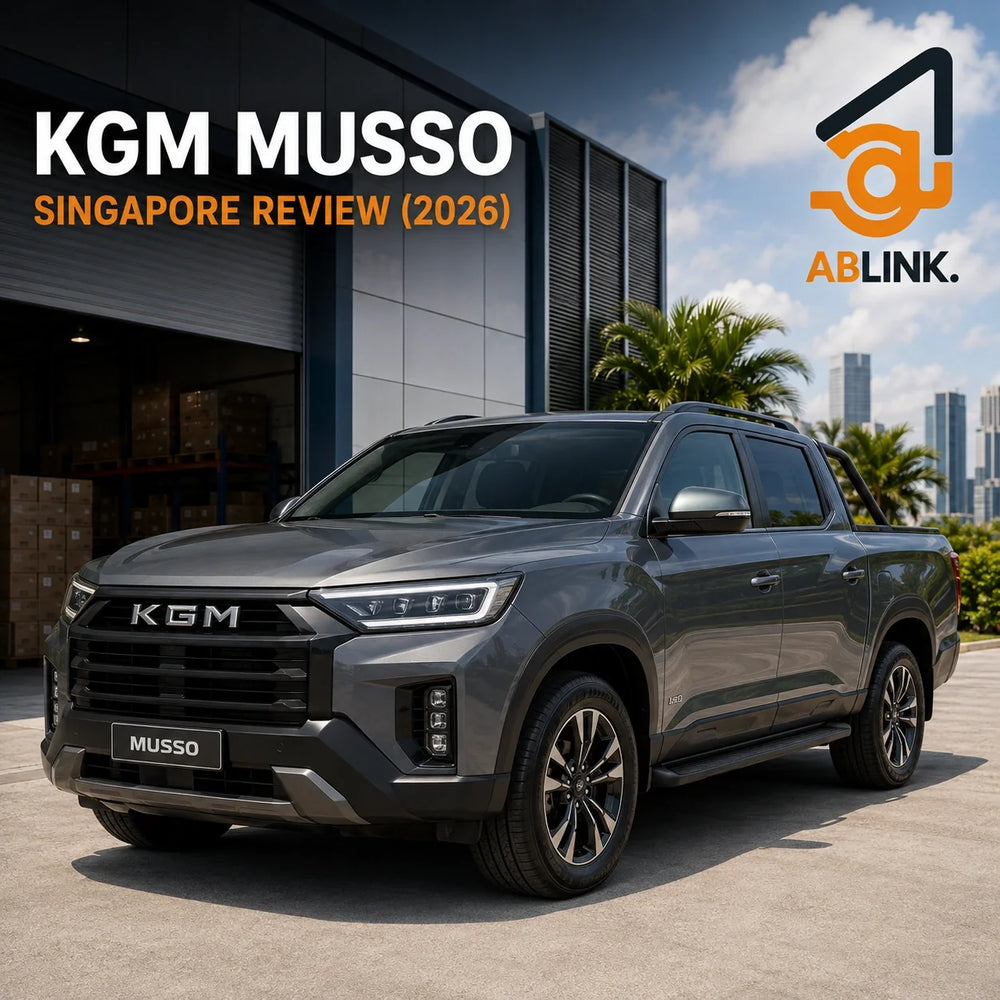
The Musso positions as the value entry into the segment. It competes on purchase price rather than on established resale performance, which suits operators planning to run a vehicle to the end of its COE rather than trade it mid-cycle.
Where the D-Max argues its case is service network depth and the predictability that comes with a long-established commercial nameplate in this market.
How does it compare to the Riddara RD6?
Different powertrain, different arithmetic. The Riddara RD6 is electric, which changes running cost, road tax treatment and grant eligibility entirely. Diesel and electric double cabs are not comparable on purchase price alone.
Our Riddara RD6 review covers the electric case, including where the physical dimensions decide the outcome before the powertrain does.
Which trades actually need a double cab?
Those that move a crew and dirty cargo in the same trip. Renovation contractors, landscaping firms, marine and offshore service teams, site survey crews, and facilities maintenance operations all fit the profile. The common thread is people plus material, not people or material.
Businesses that move only goods rarely justify the seats. Businesses that move only people rarely justify the bed.
What should you ask before signing?
Five figures decide the outcome, and all five come from the registration rather than the brochure. Ask for them in writing, on the specific unit quoted, with your accessory package included.
- Registered unladen weight — determines whether Class 3 or Class 4 applies
- Registered maximum laden weight — determines grant eligibility and road tax band
- Payload remaining after the exact accessory specification quoted
- Registered vehicle classification and the ARF basis that follows from it
- COE category and expiry date on the log card
How should you structure the purchase?
Ask for an itemised quotation. Chassis, body accessories, pre-delivery inspection and registration costs belong on separate lines. A bundled figure hides accessory margin and removes every negotiation point except the total.
Quote body price separately from COE. The two move independently, and combining them produces a number that looks like a bargain or a shock depending on where bidding closed that fortnight — neither of which tells you anything about the vehicle.
Should you buy new or used?
New brings a fresh ten-year COE and manufacturer warranty. Used costs less upfront but carries a shorter remaining COE and a service history that needs verifying properly rather than trusting to a logbook stamp.
On a dual-purpose vehicle, check the previous registration classification carefully. A unit registered under one framework and transferred under another can carry consequences the seller has no reason to raise.
What does the total cost picture look like over five years?
Purchase is one of six recurring lines. Registration cost, road tax scaled to laden weight, insurance rated on use case and driver profile, diesel, scheduled servicing and accessory replacement all repeat annually or near enough.
Model the full holding period rather than the deposit. Our five-year total cost of ownership framework sets out the lines that actually move, and the commercial vehicle selection guide works upward from the job rather than down from the vehicle.
Frequently asked questions
Is the Isuzu D-Max a commercial vehicle in Singapore?
Isuzu Singapore lists the D-Max 4X4 Double Cab under its Goods cum Passenger Vehicle range, not its Light Goods Vehicle range. It is a dual-purpose vehicle. The registered classification on the log card governs how it is taxed, not the body shape.
Do I need a Class 3 or Class 4 licence for a D-Max double cab?
Licence class follows registered unladen weight. Singapore Police Force sets Class 4 at vehicles exceeding 2,500 kg unladen weight. Most diesel double cabs sit below that ceiling, but confirm the registered figure on the log card before assigning any driver.
Does a double cab pickup fall under COE Category C?
Category C covers goods vehicles and buses, and commercial vehicles above 1,600 kg unladen weight fall into it under LTA classification. Confirm the registered category directly, because dual-purpose vehicles are classified at registration rather than by body type.
Can I claim the CVES rebate on a D-Max?
Only if the registered maximum laden weight is 3,500 kg or below. The scheme is routed strictly to MLW. Confirm the registered figure before budgeting for any rebate, and verify current eligibility with the National Environment Agency.
Does a double cab pickup get a PARF rebate?
PARF rebates apply to cars and taxis. Goods vehicles receive a pro-rated rebate on the unused portion of the COE at deregistration. Treatment for a goods-cum-passenger vehicle should be confirmed with LTA for the specific registration before you model resale value.
Is 4x4 necessary for a pickup in Singapore?
Not for road use. Singapore's road network never requires it. Four-wheel drive earns its cost on unsurfaced construction sites, reclamation ground and rain-softened access tracks, where a stuck vehicle costs a day of crew time.
How much can a double cab pickup carry?
Payload is shared between occupants and cargo against one maximum laden weight, and accessories subtract from it. A full crew consumes a meaningful share before anything is loaded. Ask for the payload figure after your exact accessory package, not the chassis figure.
Is a pickup cheaper than a van for my business?
Only when you genuinely need crew seats and an open bed together. For dry, boxed, stackable cargo a panel van usually wins on cost per cubic metre, and the goods-cum-passenger classification means the pickup rarely wins on registration cost either.
Talk to ABLINK about a double cab that fits the job
Bring your crew size, your typical load and your site access to the conversation. The team can confirm the registered unladen and laden weights, the payload remaining after your accessory package, and the classification basis on the specific unit — the figures that decide whether this platform costs you less than a van.
View the Isuzu D-Max Double Cab 4x4 listing, or browse the full pickup truck range. Selling the vehicle it replaces? See how to sell your van, lorry or truck.
Contact ABLINK on +65 8946 8228 or sales@ablink.sg. Showroom: 421 Tagore Industrial Avenue, #02-13, Singapore 787805.
Disclaimer
This article provides general reference information on goods-cum-passenger vehicles in Singapore. Vehicle specifications, registration classifications, COE premiums, tax treatment and grant eligibility change without notice, and figures marked [VERIFY] were not published by the manufacturer at the time of writing. The registered figures on an individual vehicle log card govern licence class, road tax and scheme eligibility. Confirm all specifications directly with ABLINK and verify regulatory details against official LTA, Singapore Police Force and NEA sources before any purchase decision. Nothing here constitutes financial, legal or professional advice.
Editorial and search optimisation by SingRank. Published by AB Link Pte Ltd.