Two 24ft lorries can carry the same tonnage and treat the load completely differently. The Mitsubishi Fuso Fighter FM65 is listed by ABLINK at up to 17,000 kg gross vehicle weight on a six-cylinder turbo diesel, and the reason operators choose it is rarely the rating. It is what happens to the cargo between the depot and the delivery — the part no specification sheet describes.
What is the Fuso Fighter FM65?
A six-wheel rigid heavy goods vehicle carrying a 24ft cargo deck, rated by ABLINK at up to 17,000 kg gross vehicle weight and powered by a six-cylinder turbo diesel, per its published product specifications. It sits at the top of the 24ft range alongside the Isuzu FVR90.
Where it separates from its rivals is in chassis behaviour under load rather than in headline capacity, which the two platforms share.
Why does chassis behaviour matter more than rating?
Because rating tells you what the vehicle may legally carry, not how it carries it. A reinforced chassis distributes uneven loading without flexing in ways that transmit through to the cargo, and that difference shows up in damage rates rather than in a brochure.
For operators whose cargo is fragile, high-value or irregularly shaped, damage is a real cost line. It rarely gets modelled at purchase, and it recurs on every trip.
What does uneven load distribution actually do?
It concentrates stress. A load that sits heavier over one axle, or shifts during transit, puts asymmetric force through the frame and suspension. On a chassis not built for it, that translates to flex, then to accelerated suspension fatigue, then to cargo movement.
Household removals, exhibition staging and mixed-item wholesale are the classic offenders — loads that cannot be palletised into an even block no matter how carefully they are stacked.
Why does six-cylinder torque delivery protect cargo?
Because smoother torque means fewer shock inputs. Every abrupt engagement, harsh gear change or sudden traction bite transmits through the deck to whatever is standing on it. A smoother delivery curve reduces those events across a working day.
Across hundreds of stop-start movements in Singapore estate traffic, that accumulates. Operators moving glassware, electronics, furniture or laboratory equipment feel the difference in claims rather than in comfort.
Who should be looking at the FM65 first?
Furniture movers, household relocation firms, exhibition logistics teams, laboratory and medical equipment transporters, and wholesale operators carrying mixed fragile inventory. The common thread is cargo that cannot absorb a jolt.
Construction and aggregate operators also run this platform, but for the opposite reason — chassis durability under sustained heavy loading rather than cargo protection.
Does a mover really need 17,000 kg of rating?
Often not for weight, but frequently for chassis specification. The heavier platform brings the reinforced frame, and on this range the two arrive together. That is a legitimate reason to sit at the top of the range even when the weighbridge never gets close.
Be clear with yourself about which you are buying. If you need the frame rather than the rating, say so during specification — it changes which trade-offs are acceptable.
How does the FM65 compare to the FK62?
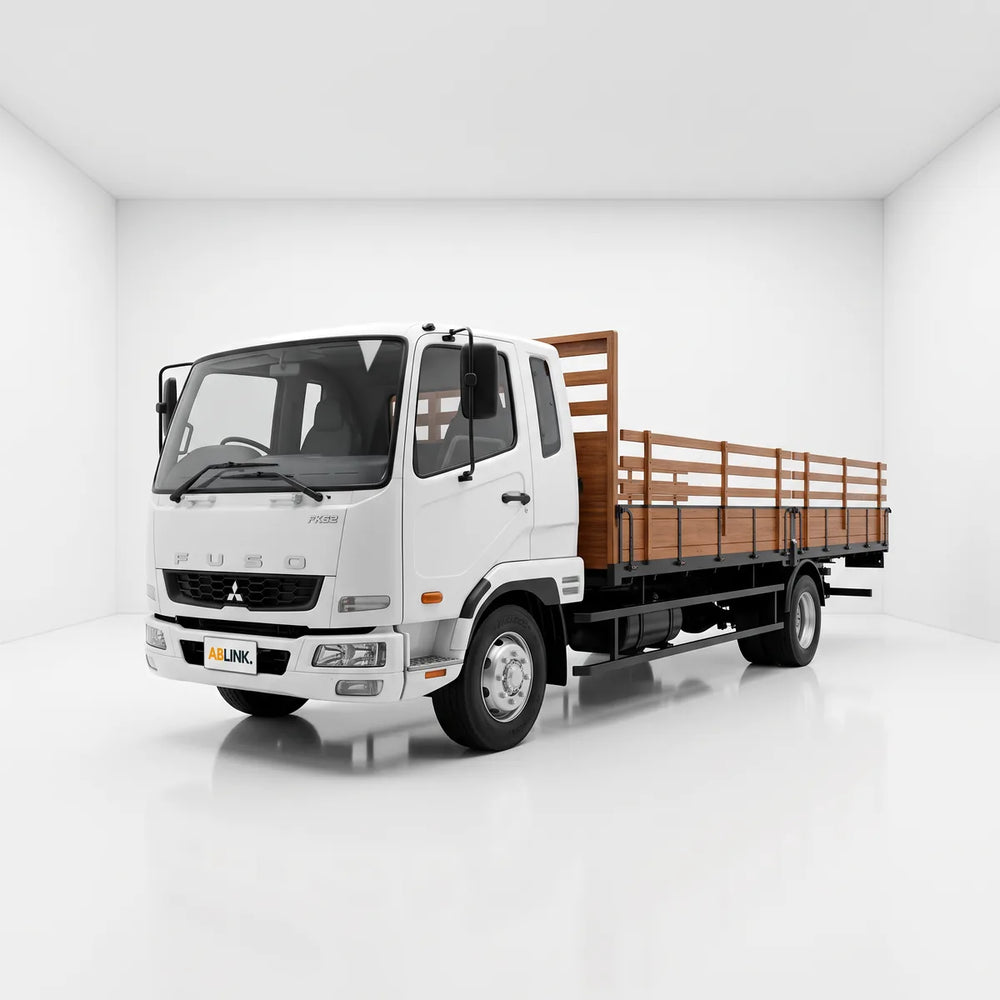
Same 24ft deck, different chassis rating. ABLINK lists the FK62 at up to 11,000 kg GVW against the FM65's 17,000 kg. The FK62 suits volume-bulky cargo that never approaches its ceiling; the FM65 suits weight-dense or fragile loading.
Road tax scales with maximum laden weight, so the lighter platform costs less annually. Our FK62 guide on right-sizing the chassis works through when specifying down is the better call.
How does it compare to the Isuzu FVR90?
Both sit at up to 17,000 kg GVW. ABLINK specifies the FVR90 with a 7.8-litre 6HK1 turbo diesel; the FM65 runs a six-cylinder turbo diesel. The practical separation is parts economics against chassis character.
Fuso parts generally cost more than Isuzu equivalents, based on ABLINK after-sales tracking across both fleets. On high-mileage routes total cost often tilts toward Isuzu; on fragile-cargo work the FM65 argues its case differently.
Which body suits fragile cargo?
Box bodies for weather protection and overnight security; curtain-side where forklift access from both sides speeds loading and reduces manual handling. Manual handling is where a meaningful share of damage actually happens.
Open-deck suits awkward or oversized items that will not fit an enclosed body. Each configuration weighs differently and subtracts differently from usable payload.
How much payload survives the body?
Maximum laden weight minus the finished vehicle weight, including bodywork and every accessory fitted. A box, a curtain-side and an open deck on the same chassis produce three different payload figures.
Ask for the figure after your exact configuration, in writing. A dealer quoting a real build answers precisely; one quoting a brochure deflects to a chassis number.
What licence does an FM65 require?
Class 4, based on registered unladen weight exceeding 2,500 kg per Singapore Police Force classification. Class 5 covers articulated prime movers rather than rigid 24ft platforms, so a Class 5 holder cannot drive this vehicle without separately holding Class 4.
Confirm the registered unladen figure on the log card before assigning a driver. Class 4 practical training takes real calendar time through approved driving centres.
Why do unladen and laden weight govern different things?
Because they measure different states. Unladen weight is the vehicle empty and decides licence class. Maximum laden weight is the vehicle plus its maximum permitted load and decides road tax band, grant eligibility and heavy goods vehicle classification.
The two move independently, and a build can sit inside one threshold while crossing the other. Never infer one from the other.
What COE category applies?
Category C, covering goods vehicles and buses. Commercial vehicles above 1,600 kg unladen weight fall into it under LTA classification. As at August 2026 the Prevailing Quota Premium sits at S$92,599, following a Quota Premium of S$93,889 at the 22 July exercise.
Premiums reset monthly, so confirm the live figure on LTA OneMotoring before signing. Our Category C and PQP guide covers the timing lever in detail.
How is Additional Registration Fee calculated?
Heavy goods vehicles are levied at 5% of Open Market Value under LTA's commercial vehicle taxation framework, far below the tiered schedule applied to passenger cars. Open Market Value reflects cost, insurance and freight plus duties on the chassis, not the body.
That treatment makes a pure goods vehicle materially more capital-efficient than a dual-purpose platform carrying the same cargo.
Will it fit your loading bays?
A 24ft platform typically exceeds 3.5 metres in overall height, above the 2.5-metre clearance common in HDB multi-storey carparks. Open-air void deck bays and street-level industrial loading accommodate it; covered and underground carparks generally do not.
Verify clearance with building management for each regular route rather than discovering the limit with a loaded vehicle and a waiting crew.
New or used on this platform?
New brings a fresh ten-year COE, manufacturer warranty and current compliance certification at handover. Used costs less upfront against a shorter remaining COE and a service history that needs verifying properly.
On a used FM65, inspect the chassis and suspension carefully. A frame that has spent a decade under uneven loading tells you more about its remaining life than the odometer does.
How should you structure the purchase?
Itemised, with body price quoted separately from COE. Chassis, body fabrication, accessories and pre-delivery inspection belong on separate lines, because bundled figures hide accessory margin.
Hire purchase suits predictable revenue and depreciation claims. Operating lease removes upfront capital and bundles maintenance, insurance and road tax into a monthly figure. Our financing guide compares the structures.
What does five-year ownership cost?
Purchase is one line of six. Registration cost, road tax scaled to laden weight, insurance, diesel, scheduled servicing and parts all recur — and on a Fuso platform the parts line deserves explicit modelling rather than an assumption.
Model the holding period. Our five-year total cost of ownership framework sets out the lines that actually move, and the 24ft buying guide covers the full range.
What should you confirm before signing?
Five registered figures, from the log card rather than the brochure, on the specific unit with your body specification included.
- Registered maximum laden weight — sets road tax band and compliance obligations
- Registered unladen weight — sets licence class at the 2,500 kg Class 4 threshold
- Confirmed payload after your exact body and accessory configuration
- Open Market Value, which sets the 5% Additional Registration Fee basis
- Overall built height, against the clearance on every regular route
Frequently asked questions
What is the GVW of a Fuso Fighter FM65?
ABLINK lists the Fighter FM65 at up to 17,000 kg gross vehicle weight on a six-cylinder turbo diesel, per its published product specifications. Confirm the registered maximum laden weight on the specific unit, since that figure governs road tax band.
Why do movers choose the FM65?
For chassis behaviour rather than rating. A reinforced frame handles uneven load distribution without flexing, and smoother six-cylinder torque delivery reduces shock inputs through the deck — both of which show up in damage rates rather than on a spec sheet.
What is the difference between the FM65 and the FK62?
Chassis rating. ABLINK lists the FK62 at up to 11,000 kg GVW against the FM65's 17,000 kg, on the same 24ft deck length. Road tax scales with laden weight, so the lighter platform costs less annually where the rating is not needed.
What licence do I need for an FM65?
Class 4, based on registered unladen weight exceeding 2,500 kg per Singapore Police Force classification. Class 5 covers articulated prime movers, not rigid 24ft lorries, so the two classes do not substitute for one another.
Are Fuso parts more expensive than Isuzu?
Generally yes, based on ABLINK after-sales tracking across both fleets. That difference recurs at every service interval, so it belongs in a five-year total cost model rather than in a purchase-price comparison.
Can an FM65 enter an HDB multi-storey carpark?
No. A 24ft platform typically exceeds 3.5 metres overall height, above the 2.5-metre clearance common in HDB multi-storey carparks. Open-air void deck bays and street-level industrial loading accommodate it.
Which body type suits fragile cargo?
Box bodies for weather protection and overnight security, or curtain-side where two-sided forklift access reduces manual handling. Manual handling is where a meaningful share of cargo damage actually occurs.
How much payload does an FM65 carry?
Maximum laden weight minus the finished vehicle weight including bodywork and accessories. Every body configuration produces a different figure, so request the payload after your exact specification rather than working from a chassis brochure number.
Talk to ABLINK about the load, not just the lorry
Bring your cargo profile and route mix. The team can confirm registered unladen and laden weights, the payload remaining after your chosen body, and whether the reinforced platform is genuinely what your cargo needs — or whether a lighter chassis carries the same load for less every year.
View the Fuso Fighter FM65 listing, or browse the full 24ft lorry range. Replacing an existing unit? See how to sell your van, lorry or truck.
Contact ABLINK on +65 8946 8228 or sales@ablink.sg. Showroom: 421 Tagore Industrial Avenue, #02-13, Singapore 787805.
Disclaimer
This article provides general reference information on 24ft commercial lorries in Singapore. Vehicle figures are quoted from ABLINK published product specifications at the time of writing; specifications, COE premiums, tax treatment and compliance obligations change without notice. The registered figures on an individual vehicle log card govern licence class, road tax and compliance. Confirm all specifications directly with ABLINK and verify regulatory details against official LTA, Singapore Police Force and NEA sources before any purchase decision. Nothing here constitutes financial, legal or professional advice.
Editorial and search optimisation by SingRank. Published by AB Link Pte Ltd.