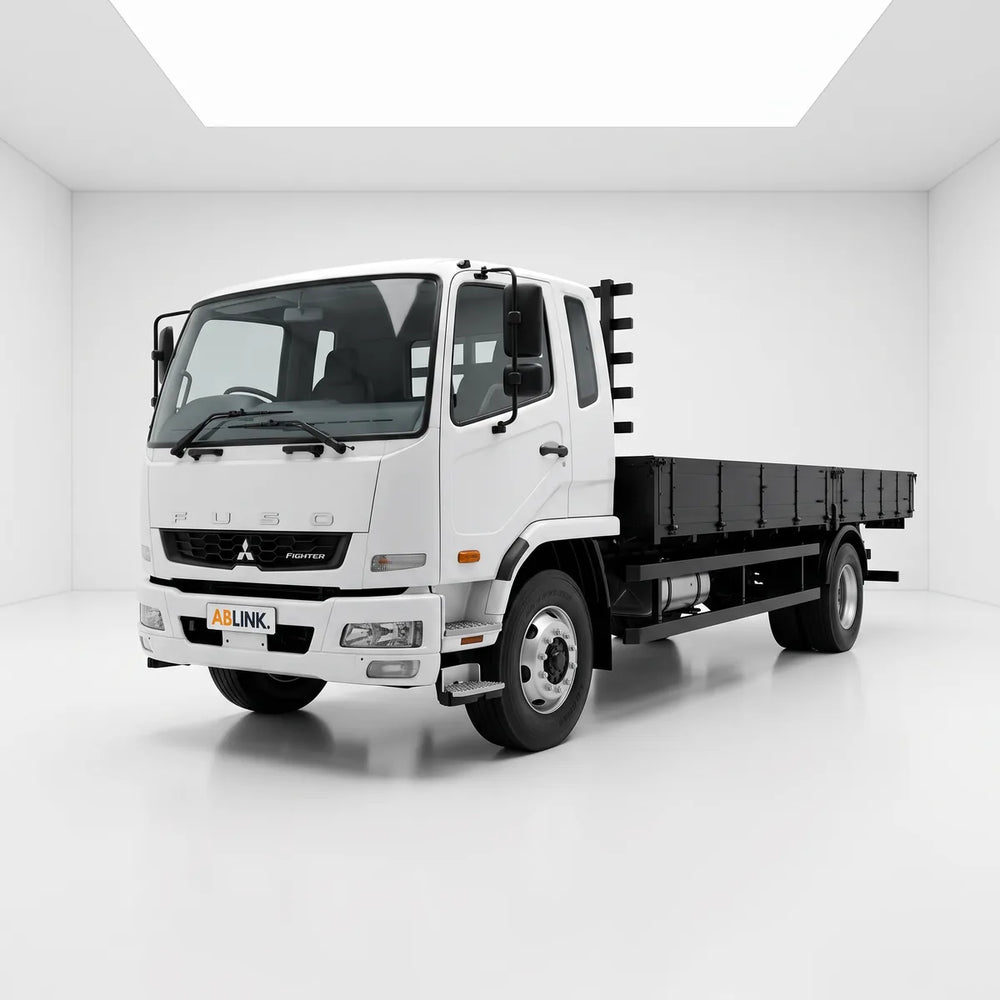
Most 24ft buyers specify upward. They compare the heaviest chassis available, assume more rating is safer, and pay road tax on capacity they never load. The Mitsubishi Fuso Fighter FK62 exists for the operators who do the opposite — a full 24ft cargo deck on a lower gross vehicle weight rating, listed by ABLINK at up to 11,000 kg GVW against the 17,000 kg of its 10-ton siblings.
What is the Fuso Fighter FK62?
A six-wheel rigid heavy goods vehicle carrying a full-length 24ft cargo deck on a chassis rated below the segment maximum. ABLINK lists it at up to 11,000 kg gross vehicle weight, powered by a six-cylinder turbo diesel, per its published product specifications.
The deck length is the same as the heavier 24ft platforms. The rating underneath it is not. That single difference is what the vehicle is for.
Why would you choose a lower GVW rating on purpose?
Because road tax scales with maximum laden weight under LTA's commercial vehicle taxation schedule. Every kilogram of rating you carry but never use is an annual cost with no operational return, repeated across the full holding period.
Over a ten-year COE cycle, that recurring difference compounds. On a fleet of three or more vehicles, it becomes a line item worth planning around rather than absorbing.
Who actually needs 17,000 kg of rating?
Operators moving weight-dense cargo. Steel, aggregate, tiles, beverage cases and building materials fill a chassis by weight long before they fill it by volume. Those loads genuinely require the heavier platform.
Furniture, packaging, exhibition staging, parcels and general distribution cargo do the opposite — they fill the deck by volume while leaving rating unused. That is the FK62's operator.
How do you tell whether you are overbuying?
Look at your weighbridge tickets, not your instinct. If your current platform rarely approaches its rated laden weight on typical routes, additional rating buys nothing except a higher annual tax band.
Payload utilisation is the diagnostic. Consistently loading well below capacity is a specification signal, and it points down the range rather than up it.
Is the FK62 a 6-ton or 7-ton lorry?
Check the log card rather than the badge. Tonne descriptors on 24ft lorries are trade shorthand for a chassis class, and listings do not always agree with one another. [VERIFY] — the registered maximum laden weight on the specific unit is the only figure that governs road tax band and compliance obligations.
This is worth raising explicitly with any dealer. A tonne badge that differs from the registered rating is not a scandal, but it is a reason to confirm the number in writing before you sign.
What does a 24ft deck actually hold?
Roughly 7.3 metres of cargo length, translating to 24 to 28 standard pallets in a single trip on a typical 24ft body. That is around 70% more deck than a 14ft platform.
For operators consolidating multiple 14ft routes into single longer runs, that deck length is where the saving comes from — fewer trips, fewer driver-hours, same cargo.
Which driving licence does an FK62 require?
It follows registered unladen weight, not deck length. Singapore Police Force sets Class 4 at motor vehicles exceeding 2,500 kg unladen weight, which covers rigid 24ft lorries. Class 5 applies to articulated vehicles rather than rigid platforms.
Confirm the registered unladen figure on the log card before assigning a driver. A vehicle waiting on a licence earns nothing while the training clears.
Why do unladen and laden weight point to different rules?
Because they measure different things and govern different frameworks. Unladen weight is the vehicle empty and decides licence class. Maximum laden weight is the vehicle plus its maximum permitted load and decides road tax band, grant eligibility and heavy goods vehicle classification.
The two move independently. Never infer a licence class from a laden figure, or a tax band from an unladen one.
What COE category applies?
Category C, covering goods vehicles and buses. Commercial vehicles above 1,600 kg unladen weight fall into this category under LTA classification. As at August 2026 the Prevailing Quota Premium sits at S$92,599, following a Quota Premium of S$93,889 at the 22 July exercise.
Premiums reset on the 1st of each month, so the figure at quotation is rarely the figure at registration. Confirm the live number on LTA OneMotoring before committing.
How does Additional Registration Fee work on this class?
Heavy goods vehicles are levied at 5% of Open Market Value under LTA's commercial vehicle taxation framework — far below the tiered schedule applied to passenger cars and goods-cum-passenger vehicles. Pure goods vehicles are capital-efficient in a way dual-purpose platforms are not.
Open Market Value reflects cost, insurance and freight plus duties on the chassis, not the body or accessories. Body fabrication sits outside that basis.
What body configurations suit the FK62?
Box, curtain-side, tailgate and open-deck all fit the platform. The choice follows cargo type rather than preference: box protects and secures, curtain-side allows forklift access from both sides, open-deck takes awkward or oversized loads.
Each body weighs differently, and each subtracts differently from payload. Specify the body first, then ask for the payload figure that survives it.
How much payload actually remains?
Maximum laden weight minus the finished vehicle weight, including bodywork and every accessory fitted. A curtain-side, a box and an open deck on the same chassis produce three different payload figures.
Ask for the number after your exact body specification, never the chassis brochure figure. A dealer quoting a real build can answer precisely; one quoting a brochure will deflect.
How does the FK62 compare to the FM65?
Same deck, different rating. ABLINK lists the Fighter FM65 at up to 17,000 kg GVW against the FK62's 11,000 kg, both on six-cylinder turbo diesel power. The FM65 suits weight-dense loading; the FK62 suits volume-bulky loading.
Neither is the better vehicle in the abstract. The right one is whichever matches your weighbridge data.
How does it compare to the Isuzu FVR90?
The FVR90 sits in the same 17,000 kg GVW territory as the FM65, with a 7.8-litre 6HK1 turbo diesel per ABLINK's published specifications. Against the FK62 it is a heavier-rated platform for a different cargo profile.
Our 24ft lorry buying guide sets all three side by side, and the 6-to-10-tonne comparison works through the rating decision in detail.
Is Fuso parts cost higher than Isuzu?
Generally yes, based on ABLINK's after-sales tracking across both fleets. That difference belongs in a five-year total cost model rather than in a purchase-price comparison, because it recurs every service interval.
Where Fuso earns the difference is chassis behaviour under uneven loading and smoother torque delivery, which matters for fragile cargo and for operators running consistently loaded.
Which industries suit this platform?
Furniture movers, parcel consolidators, e-commerce distribution, exhibition logistics and general wholesale trade. The common thread is cargo that fills space before it fills rating.
Construction, aggregate haulage and building material supply generally point the other way, toward the heavier chassis. Our construction lorry guide covers that end of the range.
Should you buy new or used in this class?
New brings a fresh ten-year COE, manufacturer warranty and current compliance certification at delivery. Used costs less upfront against a shorter remaining COE and a service history that needs verifying properly rather than trusting to a logbook stamp.
On a used 24ft platform, check the registered laden weight against the tonne badge carefully. Buyers who assume the two match sometimes discover a different road tax band than they budgeted.
How should the purchase be structured?
Itemised, with body price quoted separately from COE. Chassis, body fabrication, accessories and pre-delivery inspection belong on separate lines, because a bundled figure hides accessory margin and collapses every negotiation point into one number.
Hire purchase suits operators with predictable revenue and a reason to claim depreciation. Operating lease removes upfront capital and bundles maintenance, insurance and road tax into a monthly figure. Our commercial vehicle financing guide compares the structures.
What does five-year ownership cost?
Purchase is one line of six. Registration cost, road tax scaled to laden weight, insurance, diesel, scheduled servicing and tyre replacement all recur — and the road tax line is precisely where an over-specified chassis keeps charging you.
Model the full holding period. Our five-year total cost of ownership framework sets out the lines that actually move.
What should you confirm before signing?
Five registered figures, all from the log card rather than the brochure, on the specific unit with your body specification included.
- Registered maximum laden weight — sets road tax band and compliance obligations
- Registered unladen weight — sets licence class at the 2,500 kg Class 4 threshold
- Confirmed payload after your exact body and accessory configuration
- Open Market Value, which sets the 5% Additional Registration Fee basis
- COE category and expiry date
Frequently asked questions
What is the GVW of a Fuso Fighter FK62?
ABLINK lists the Fighter FK62 at up to 11,000 kg gross vehicle weight on a six-cylinder turbo diesel, per its published product specifications. Confirm the registered maximum laden weight on the specific unit, because that figure governs road tax band.
Is the FK62 a 6-ton or 7-ton lorry?
Tonne descriptors are trade shorthand for a chassis class and listings do not always agree. The registered maximum laden weight on the log card is the only figure that governs road tax and compliance, so verify it in writing before signing.
What licence do I need for a 24ft FK62?
Class 4, based on registered unladen weight exceeding 2,500 kg per Singapore Police Force classification. Class 5 covers articulated prime movers rather than rigid 24ft lorries. Confirm the registered unladen figure before assigning a driver.
Why choose the FK62 over a 10-ton 24ft lorry?
Because road tax scales with maximum laden weight. If your cargo fills the deck by volume rather than by weight, a lower-rated chassis carries the same load while costing less in annual road tax across the ownership cycle.
How many pallets does a 24ft deck carry?
Around 24 to 28 standard pallets on a typical 24ft body, across roughly 7.3 metres of cargo length. That is approximately 70% more deck than a 14ft platform, which is where route consolidation savings come from.
Does the FK62 fit an HDB multi-storey carpark?
No. A 24ft platform typically exceeds 3.5 metres in overall height, well above the 2.5-metre clearance common in HDB multi-storey carparks. Open-air void deck bays and street-level industrial loading accommodate it.
Are Fuso parts more expensive than Isuzu?
Generally yes, based on ABLINK's after-sales tracking across both fleets. That difference belongs in a five-year cost model rather than a purchase-price comparison, since it recurs at every service interval.
What body types fit the FK62?
Box, curtain-side, tailgate and open-deck all fit the platform. Each body weighs differently and subtracts differently from usable payload, so specify the body first and ask for the payload figure that results.
Talk to ABLINK about right-sizing the chassis
Bring your weighbridge data and typical route profile. The team can confirm registered unladen and laden weights, the payload remaining after your chosen body, and whether a lower-rated chassis genuinely carries your loads — which is the difference between buying capacity and paying for it.
View the Fuso Fighter FK62 listing, or browse the full 24ft lorry range. Replacing an existing unit? See how to sell your van, lorry or truck.
Contact ABLINK on +65 8946 8228 or sales@ablink.sg. Showroom: 421 Tagore Industrial Avenue, #02-13, Singapore 787805.
Disclaimer
This article provides general reference information on 24ft commercial lorries in Singapore. Vehicle figures are quoted from ABLINK published product specifications at the time of writing; specifications, COE premiums, tax treatment and compliance obligations change without notice, and figures marked [VERIFY] were not confirmed across sources at the time of writing. The registered figures on an individual vehicle log card govern licence class, road tax and compliance. Confirm all specifications directly with ABLINK and verify regulatory details against official LTA, Singapore Police Force and NEA sources before any purchase decision. Nothing here constitutes financial, legal or professional advice.
Editorial and search optimisation by SingRank. Published by AB Link Pte Ltd.