Updated 23 September 2026 · SingRank Singapore
The electric 14ft lorry Singapore buyers can order today comes down to two live models: the SANY FR601 and the Qingling EQ2. Both are heavy goods vehicles that stay out of the VPC scheme by weight. Neither qualifies for the 3,000kg electric-van licence rule, so a Class 3 driver is legal only if the finished truck's log-card unladen weight is 2,500kg or less.
That last sentence is the one most sales conversations skip. Marketplace adverts for 14ft EV lorries print "No VPC Required ! Class 3 Driving Licence" as if it were a feature of the model.
Half of it holds. Whether the other half holds depends on the body you order, and you can check it yourself before you sign. If your whole driver team holds Class 3, the licence question is the most important thing to settle in this purchase, so we start there.
Key takeaways
- The SANY FR601 and Qingling EQ2 are both 14ft electric trucks registered as heavy goods vehicles, above the 3,500kg line that defines an electric light goods vehicle.
- Because of that, the 15 June 2026 rule letting Class 3 drivers handle electric goods vehicles up to 3,000kg unladen does not reach them. For these trucks, the ordinary 2,500kg unladen line applies.
- Neither truck needs a Vehicle Parking Certificate on published weights, because the VPC applies above 5,000kg maximum laden weight.
- Registered on a COE won in or after the first September 2026 exercise, both sit in the S$15k HVZES band, paid in three tranches over two years (LTA, 2026).
- Pick the FR601 for a 10-year motor warranty; pick the EQ2 for longer listed range and 120kW DC charging.
Which electric 14ft lorries can you buy in Singapore?
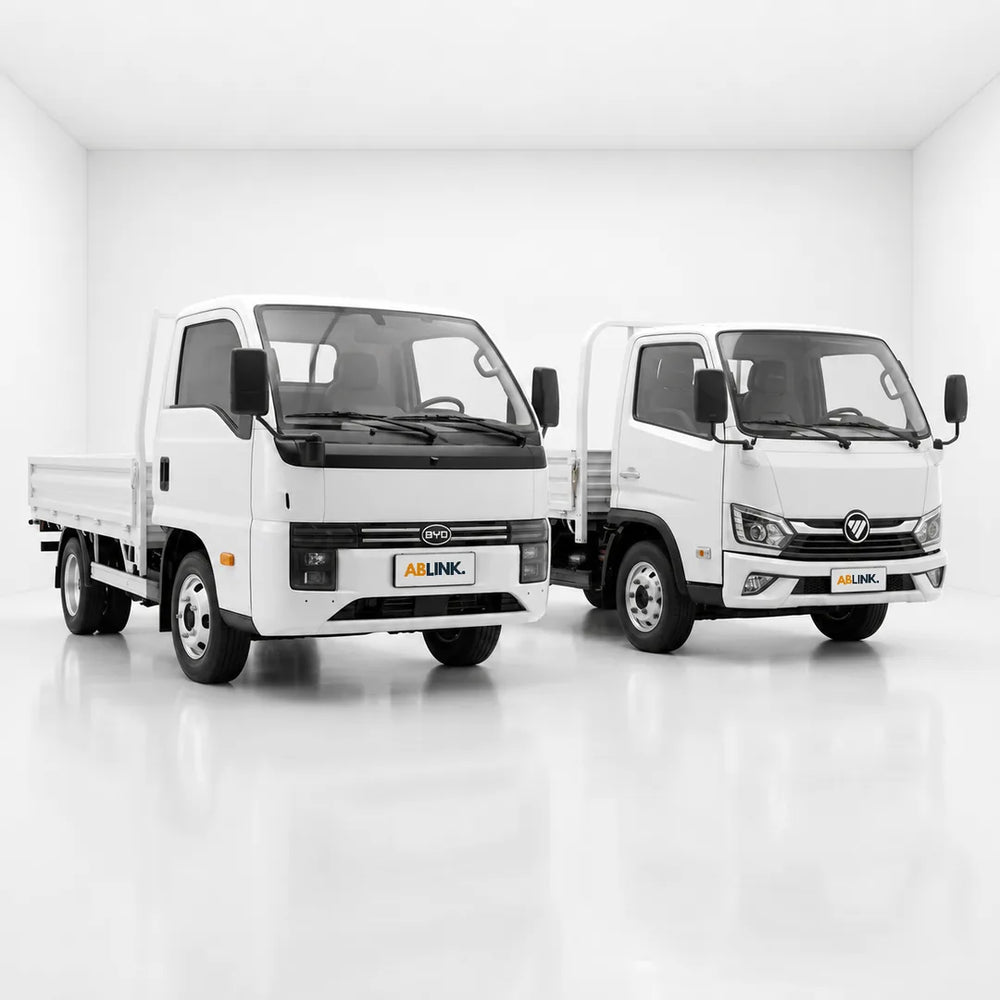
ABLINK's live 14ft range lists two electric models today: the SANY FR601 and the Qingling EQ2. Six other 14ft trucks in the range run on diesel: the Hino 300, three Isuzu models and two Mitsubishi models.
Each electric listing offers four main bodies (open deck, hood, box and freezer), a tailgate add-on and five charger options, from a 7kW AC wallbox up to a 120kW DC unit.
Both trucks are sold as a chassis that gets a body built on it. Qingling's Singapore distributor says so plainly: the truck "is supplied as a cab-and-chassis" (Qingling Singapore, 2026). That phrase is why no brochure can promise you a licence class.
If you searched for an electric lorry Singapore dealers can register as a light goods vehicle, or any EV lorry that stays inside the van-style licence rules, compare the electric 10ft lorries compared in our sister guide first. A 10ft EV can be a genuine electric light goods vehicle. A 14ft one, on current models, is not.
SANY FR601 vs Qingling EQ2: how do they compare?
On paper, these trucks are closer than their marketing suggests. Payload is within 10kg on the makers' own figures. Where they really split is motor warranty, charging speed and how range was measured.
| Point to compare | SANY FR601 | Qingling EQ2 |
|---|---|---|
| Vehicle class | Heavy goods vehicle, GVW 5,000kg | Heavy goods vehicle, COE Category C |
| Bare chassis weight | 2,340kg (chassis spec) | Not published on the maker's site |
| Payload claimed | Up to 2,500kg on road | 2,510kg |
| Battery (ABLINK listing) | 103.47kWh | 100.46kWh |
| Range (ABLINK listing) | 300km | 350km |
| Published charging figure | 22kW AC highlighted; DC rate not published by the distributor | 120kW DC, 20–80% in about 30 minutes |
| Vehicle warranty | 5 years or 100,000km | 5 years or 100,000km |
| Motor warranty | 10 years or 400,000km | 5 years or 200,000km |
| Battery warranty | 10 years or 400,000km | 10 years or 400,000km |
| VPC needed? | No, at 5 tonnes GVW | No, per launch materials |
| Class 3? | Only if log-card ULW is 2,500kg or less | Only if log-card ULW is 2,500kg or less |
| Price | View latest price in ABLINK's 14ft range | |
Sources: warranty, battery and range rows from ABLINK's live listings (23 September 2026); class, weight and payload rows from each distributor's published material, cited in the sections below. Real range depends on load, body and route, so treat listing range as a comparison figure, not a promise.
Can a Class 3 driver drive an electric 14ft lorry?
Only when the individual truck's unladen weight on its log card is 2,500kg or less. Being electric changes nothing about that test for a 14ft truck.
The Singapore Police Force's licence schedule gives Class 3 "motor tractors and other motor vehicles (not being electric light goods vehicles or electric small buses) the weight of which unladen does not exceed 2,500kg" (SPF, 2026). Class 4 starts where a load-carrying vehicle's unladen weight exceeds 2,500kg.
Notice what decides it: not the deck length, the plate or the battery, but the unladen weight of the complete vehicle as registered, body included.
Now apply that to the two trucks. ABLINK's own FR601 review records the chassis at 2,340kg, citing the published chassis specification (SANY FR601 full review). That leaves 160kg for everything bolted on top before the truck crosses into Class 4.
Qingling doesn't publish a chassis figure on its site. It says the EQ2 "is intended for Class 3 / 3A licence holders, depending on the final bodied weight", and asks buyers to confirm the log-card unladen weight for their specific build (Qingling Singapore, 2026).
So the distributor of one of these two trucks agrees with the rule: licence class is a log-card fact, not a model fact. For the wider picture of what each licence covers, see our guide to Class 3 against Class 4 licence rules for lorries.
Why doesn't the 3,000kg eLGV rule cover them?
Because the 3,000kg allowance belongs to electric light goods vehicles, and SPF defines those by laden weight. Since 15 June 2026, Traffic Police have allowed Class 3 and 3A holders to drive any electric light goods vehicle or electric small bus weighing up to 3,000kg unladen, where the old ceiling was 2,500kg (SPF, 14 June 2026).
"Electric light goods vehicles are defined as goods vehicles that are propelled wholly by electricity, with a maximum laden weight of 3,500kg." — Singapore Police Force, 14 June 2026
SANY's FR601 is registered at 5 tonnes gross. Qingling describes the EQ2 as a "heavy goods vehicle". LTA's OneMotoring puts heavy goods vehicles at a maximum laden weight from 3,501kg to 16,000kg (OneMotoring, 2026). Neither truck is an eLGV, so neither gets the extra 500kg.
SPF notes that batteries usually make these vans 400kg to 500kg heavier than their diesel equivalents, which is why their line moved to 3,000kg. A 14ft electric truck sits outside the category that allowance was written for.
Watch for a salesperson quoting the June 2026 change as if it covered every electric lorry. It doesn't.
Does a box body change the licence class?
It can, and this is where the "Class 3, no VPC" line needs care. A body adds its own weight to the unladen figure. On the FR601's published chassis weight, any body, tailgate or insulation set that adds more than 160kg would push the registered unladen weight past 2,500kg. That truck would then need a Class 4 driver.
We can't give you body weights, because neither distributor publishes them for these chassis, and they vary by builder and material. That's exactly why the check has to happen on the unit you are buying, not on the model name.
Our position, labelled as our judgement: if you order a freezer body, plan for Class 4 drivers until the registered unladen weight proves otherwise. A refrigeration unit, insulated panels and a heavier floor are the configuration most likely to use up a margin that small. An open deck is the configuration most likely to stay inside it. A hood or dry box sits between the two, so ask.
What's at stake if you guess wrong? Your Class 3 driver is licensed for a vehicle of 2,500kg unladen or less, not for the truck parked in your yard.
SPF's June 2026 release is explicit: where the 2,500kg line applies, anything heavier needs a Class 4 or Class 4P licence. Finding that out after delivery means retraining drivers or reassigning routes for a truck you've already paid for.
Do you need a VPC for an electric 14ft lorry?
Not for these two trucks on their published weights. OneMotoring requires a valid Vehicle Parking Certificate for a heavy goods vehicle with a maximum laden weight over 5,000kg. The FR601's distributor states that a truck registered at 5 tonnes GVW needs no Vehicle Parking Certificate (SANY distributor, 2026). The EQ2's launch coverage reports the same: no VPC is required (AutoApp, November 2025).
So this half of the sales line holds. VPC status reads maximum laden weight, which is a rating, not the licence test's unladen figure. Choosing a box doesn't move you into the VPC scheme; it only moves you towards the Class 4 line.
Why this matters: leaving a heavy vehicle anywhere other than its designated lot between midnight and 6am can cost up to $1,000 in fines or up to 3 months in jail (OneMotoring, 2026).
And lots are scarce. In September 2026, the Senior Minister of State for Transport said many heavy vehicle operators and drivers struggle to find a VPC with a lot attached (The Straits Times, 14 September 2026). Stay at or under 5,000kg and you skip that search entirely. Our full explainer covers when a lorry needs a Vehicle Parking Certificate.
Which HVZES band are they in after 3 September 2026?
Both sit in the S$15k band. LTA reduced the Heavy Vehicle Zero Emissions Scheme incentive from S$40k to S$15k "for lighter zero-tailpipe emission heavy vehicles", meaning a maximum laden weight of more than 3,500kg and up to 7,000kg (LTA, 2 September 2026). At 5,000kg, the FR601 falls inside that range, and so does the EQ2 as a heavy goods vehicle under the VPC line.
Three details decide what you actually receive:
- The S$15k covers any COE won in the first September 2026 exercise or later (LTA).
- It is paid in three tranches over two years, not as a single discount (LTA).
- A truck registered on a COE obtained before the first September 2026 exercise still receives S$40k, regardless of its laden weight (LTA).
You'll still find the old S$40k figure in launch coverage from November 2025, which reported the EQ2 as qualifying for the S$40k incentive (AutoApp, 2025). It was accurate then. For a new COE today, it isn't.
If a unit is offered with the higher figure, ask one question: which bidding exercise did this COE come from? Get the answer in writing. For context, zero-tailpipe models made up 55% of new registrations among lighter heavy vehicles in July 2026 (LTA, 2 September 2026).
Road tax and the charger grant
Both trucks pay the same road tax, because it follows the weight band. In the band above 3.5 tonnes and up to 7 tonnes laden, an electric heavy goods vehicle pays $262 base road tax per half-year.
On top sits an additional flat component: $50 per half-year during 2026, stepping up to $75 through 2027 and then $125 per half-year from 1 January 2028 (OneMotoring, 2026). Our guide to road tax for vans and lorries, diesel against electric sets that against a diesel 14ft.
Charging hardware has its own grant. Under LTA's Electric Heavy Vehicle Charger Grant, half of the installation bill can be co-funded, up to S$30k for each charger. Installation has to wait until LTA's Letter of Offer arrives (LTA, 2026).
Install first and apply later, and you lose it. On ABLINK's listings, the 60kW and 120kW DC chargers carry the note "EHVCG grant 50%".
Range and charging for your route
ABLINK's listings give 300km for the FR601 and 350km for the EQ2. Both makers publish harder numbers too, and they're worth reading together.
For the FR601, the SANY distributor ran its own road test and reported 290km in total, 50km more than SANY's own claim, while "fully laden with a counterweight" (SANY distributor road test). Empty, with the standard open deck, it averaged around 248Wh per kilometre.
For the EQ2, Qingling Motors quotes up to 400km "at full load and constant speed" (Qingling Motors, November 2025). Its Singapore distributor is candid that load, body, traffic and route all move the real figure.
Charging is where they split. On a 120kW DC charger, Qingling Singapore says the EQ2 climbs from 20% to 80% in roughly half an hour. SANY's distributor, by contrast, highlights 22kW AC charging for the FR601. On ABLINK's listings, a 7kW AC charger is shown at 8 to 10 hours and a 22kW AC charger at 5 to 7 hours.
Here's the practical read. If the truck sleeps at your depot every night and runs one shift, both ranges cover a typical island day with room to spare, and a 22kW AC point will do. If the truck runs two shifts, or you can't charge at your own premises, the EQ2's published DC figure is the one to weigh most.
Warranty is where they differ most
Both trucks carry a 10-year or 400,000km battery warranty and a 5-year or 100,000km vehicle warranty on ABLINK's listings. Where they part company is the motor. SANY covers the FR601's motor for 10 years or 400,000km. Qingling's cover on the EQ2 motor stops at 5 years or 200,000km.
If you intend to keep the truck for ten years, the FR601 covers its drive motor for the whole period. With the EQ2, years six to ten are yours to carry on the motor. That doesn't make the EQ2 weaker; it shifts the ownership risk to you, so price it in now.
Electric 14ft lorry Singapore verdict by type of work
These are our calls for the buyers we meet most often. Each assumes the licence check in the next section is done first.
- Class 3 driver team, open deck, depot charging. The FR601. It's the lighter documented chassis, and an open deck is the build most likely to keep the log card under 2,500kg.
- Two shifts a day or no overnight charging. The EQ2, on its published DC rate and longer listed range. Ask for the FR601's DC rate before ruling it out.
- Cold-chain with a freezer body. Either truck, but budget for Class 4 drivers. We wouldn't commit a Class 3-only team to a freezer build without the registered figure in hand.
- Keeping the truck for ten years. The FR601, for the motor warranty.
- Chasing the old S$40k grant. Skip it as a reason to choose a model. Both trucks sit in the same HVZES band; only the COE's bidding exercise changes the amount (LTA).
If a diesel 14ft still fits better, our guide on lorry sizes from 10ft to 24ft sets out when a 14ft is the right size at all.
Seven checks before you sign
- Choose the body first: open deck, hood, box or freezer, plus any tailgate.
- Ask for the registered unladen weight of that exact configuration, in writing, before you pay a deposit.
- Compare it with 2,500kg. At or under, Class 3 works. Over, your driver needs Class 4 or 4P.
- Confirm the maximum laden weight. At 5,000kg or under, no VPC is needed.
- Ask which COE bidding exercise the unit will be registered on, because that decides S$15k or S$40k under HVZES (LTA).
- If you want a 60kW or 120kW DC charger, apply for the EHVCG and wait for LTA's Letter of Offer before installation.
- Check the motor warranty term against how long you plan to keep the truck.
Every check can be verified without any seller: licence classes on the SPF site, VPC and road tax on OneMotoring, grants on LTA. You shouldn't have to take anyone's word for it, including ours.
Where to see both trucks side by side
ABLINK lists the SANY FR601 and the Qingling EQ2 next to the diesel 14ft models in one live range, with every body and charger option shown per truck. Open the 14ft range to view the latest price, pick the body you need, then ask our team for the registered unladen weight of that build before you assign a driver.
You can also visit us at 421 Tagore Industrial Avenue or reach us through the contact page.
For the single-model detail, read the SANY FR601 full review and the Qingling EQ2 full guide.
Frequently asked questions
Can Class 3 drive an electric 14ft lorry?
Yes, but only if that particular truck's unladen weight on the log card is 2,500kg or less. Being electric doesn't raise the line: the 3,000kg electric-van allowance doesn't apply, because they are heavy goods vehicles above 3,500kg maximum laden weight. Check the registered figure for the exact body before assigning a driver.
Does the Qingling EQ2 need a VPC?
No, on its launch materials. A Vehicle Parking Certificate is required for heavy goods vehicles with a maximum laden weight over 5,000kg, and the EQ2 was launched in Singapore as not needing one. The body you choose affects its unladen weight and licence class, not the VPC requirement, which reads maximum laden weight.
Is the SANY FR601 a Class 3 lorry?
It can be. Its chassis weighs 2,340kg on its published specification, so a Class 3 driver is legal only if the finished truck, body included, is registered at 2,500kg unladen or less. That leaves 160kg for the body and fittings. Ask for the registered unladen weight of your configuration in writing.
How many tons is an electric 14ft lorry?
Both electric 14ft lorries sold in Singapore are rated around 5 tonnes. SANY registers the FR601 at 5,000kg gross vehicle weight, and the Qingling EQ2 is a heavy goods vehicle that stays under the 5,000kg VPC line. Payload is claimed at up to 2,500kg for the FR601 on road and 2,510kg for the EQ2.
Do these trucks still get the S$40k HVZES?
Not on a new COE. From the first September 2026 bidding exercise, heavy EVs above 3,500kg and up to 7,000kg maximum laden weight receive S$15k, paid in three tranches over two years (LTA, 2026). A truck on a COE obtained before that exercise still receives S$40k. Ask which exercise the unit's COE came from.
Which is better, the SANY FR601 or the Qingling EQ2?
Neither wins outright. For long ownership, pick the FR601, with its 10-year motor warranty and a documented light chassis.
For heavy daily mileage, pick the EQ2, with 120kW DC charging and a longer listed range. Payload, VPC status and grant band are effectively the same, so choose by route, body and how long you'll keep the truck.
Disclaimer
This article is general information, not legal or licensing advice. Licence classes are set by the Singapore Police Force; VPC, road tax and HVZES by LTA; charger grants by LTA and subject to its Letter of Offer.
Vehicle specifications are quoted from each distributor's published material and ABLINK's listings as of 23 September 2026 and may change. Vehicle prices are shown only on the live listing and exclude grant amounts unless stated there.
Confirm the registered weights of any electric 14ft lorry Singapore sellers offer you before purchase.