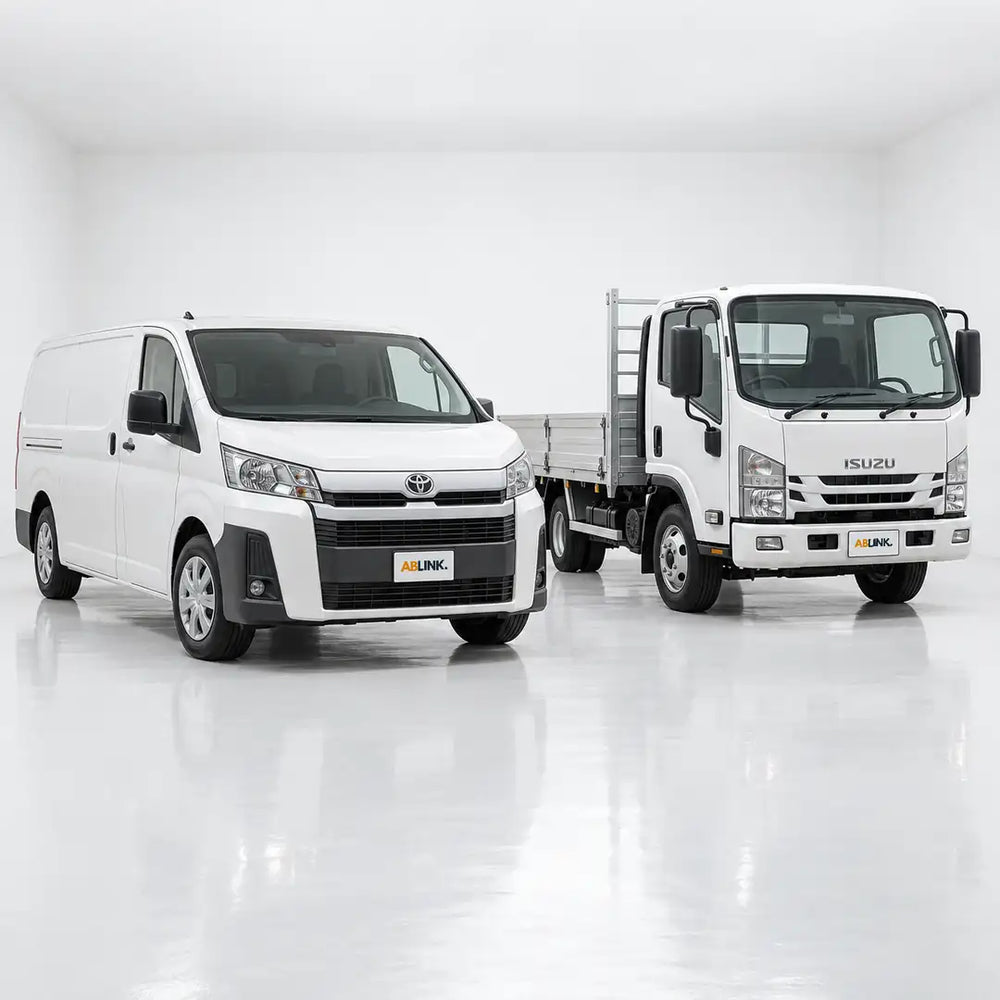
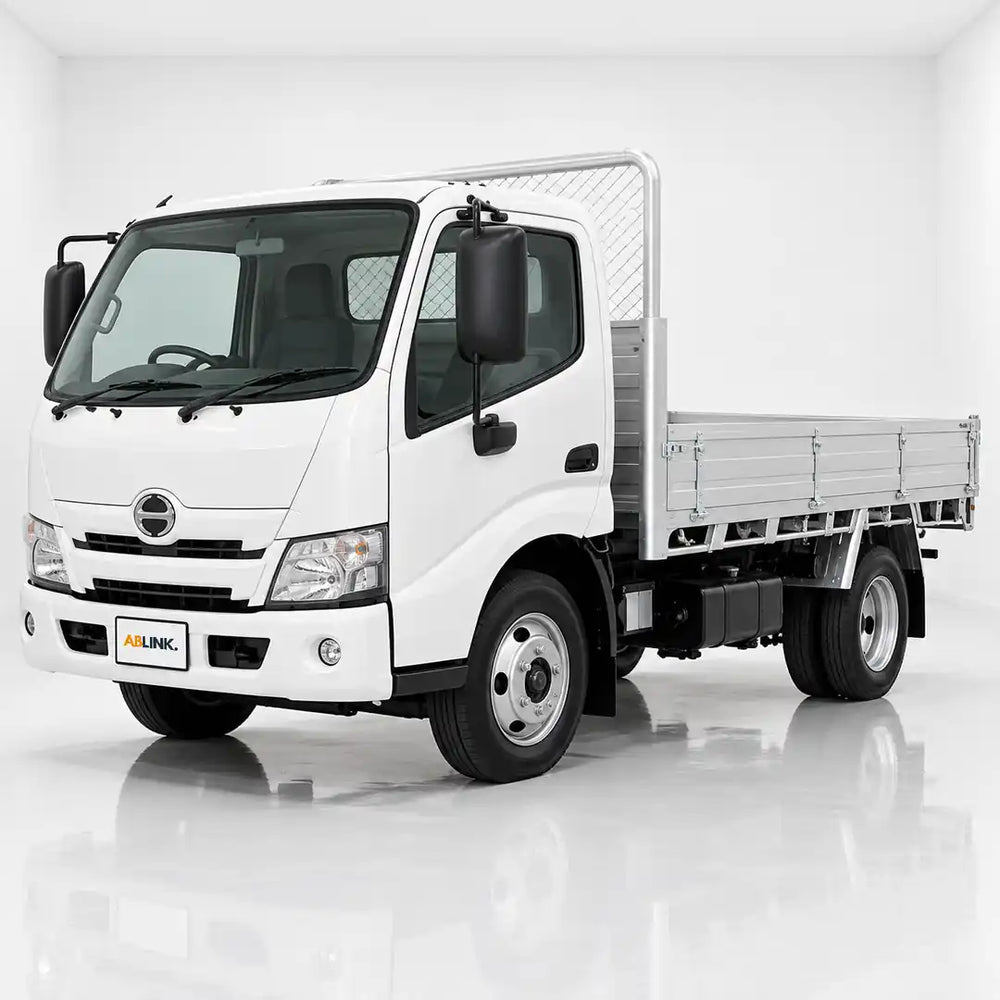
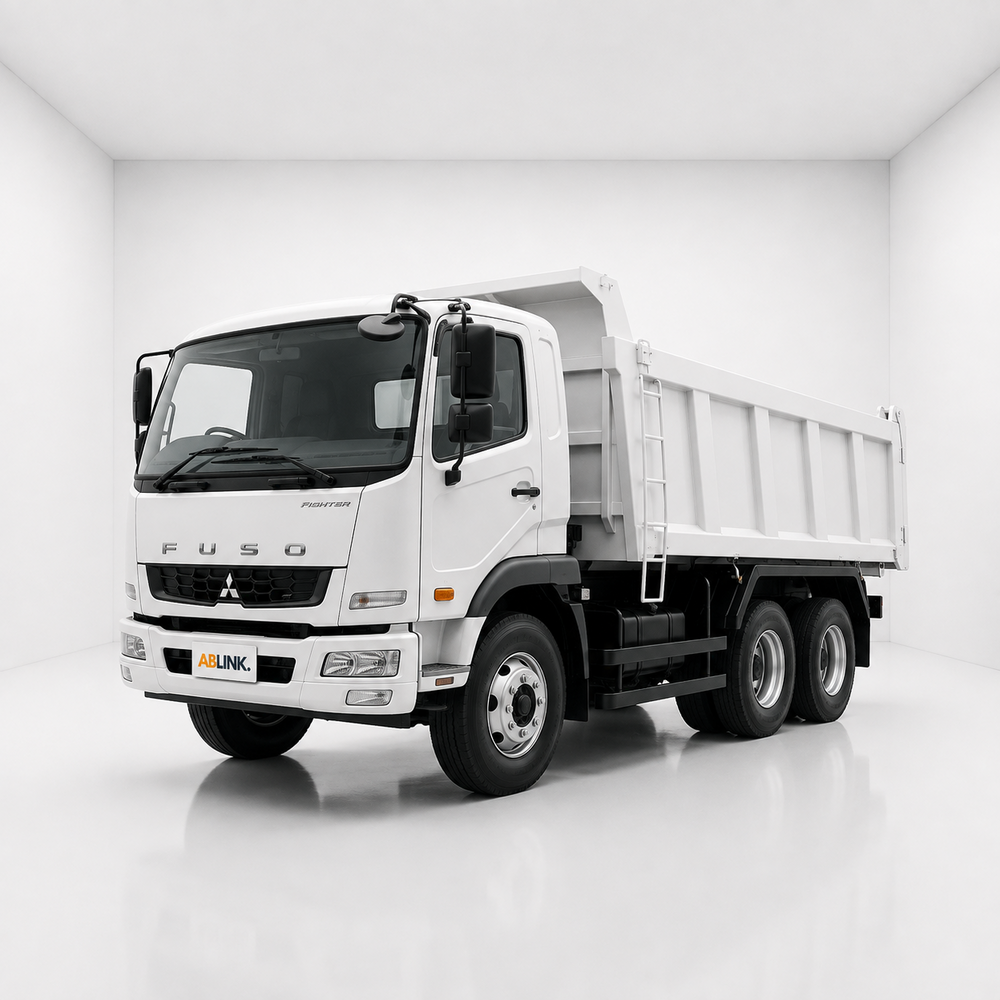
The Mitsubishi Fuso Canter is a medium-duty 14ft truck. ABLINK's product listing carries two selectable variants — the FEB21 and the FEB71 (VPC) — while the 14ft truck range also lists an FEA21. All share the Duonic 2.0 dual-clutch automated manual transmission, Electronic Stability Program and Advanced Emergency Braking System. Body price is quoted separately from COE.
Isuzu's N-Series has a variant guide. Hino's light-truck range has one. The Canter has not had one — despite being one of the most widely deployed 14ft platforms on Singapore roads. This guide closes that gap using ABLINK's own listed specifications.
What is the Fuso Canter, and where does it sit?
The Canter is Mitsubishi Fuso's medium-duty truck line, positioned as a 14ft platform in Singapore. It competes directly against the Isuzu N-Series and the Toyota Dyna and Hino Dutro pairing. ABLINK describes it as offering safety and comfort with current-generation technology.
Fuso has built the Canter since 1963, and the line now runs in its eighth generation globally. Mitsubishi Fuso Truck and Bus Corporation sits within Daimler Truck. That parentage explains the safety equipment level, which is closer to a European commercial vehicle than to a traditional Japanese light truck.
What is the difference between the FEB21 and the FEB71?
The two variants differ primarily in wheelbase and body configuration. ABLINK's editorial material identifies the FEB21 as the shorter-wheelbase option and the FEB71 as the standard 14ft configuration. The FEB71 carries a VPC designation on ABLINK's product listing.
Exact wheelbase, deck length, unladen weight and payload are not published per variant on the listing. Consequently, these are the four figures to request before you choose.
| Variant | Configuration | Best suited to |
|---|---|---|
| FEA21 | Lightest of the three | Where unladen weight has to stay low for Class 3 reach |
| FEB21 | Shorter wheelbase | Tighter urban routes, frequent kerbside stops, constrained yards |
| FEB71 (VPC) | Standard 14ft | Full 14ft deck utilisation, palletised distribution runs |
The FEA21 discrepancy worth raising
ABLINK's vehicle browser lists an FEA21. However, the Canter product page currently offers only FEB21 and FEB71 as selectable variants. Ask ABLINK which listing is current before you shortlist on the FEA21, since the two views disagree.
What does the Duonic 2.0 transmission actually change?
Duonic 2.0 is a dual-clutch automated manual transmission. It switches between two clutches rather than interrupting drive to change gear. As a result, the Canter delivers gear changes without the shift shock typical of a single-clutch automated manual.
Three operational consequences follow. First, driver fatigue drops sharply on routes with frequent stops, because there is no clutch pedal. Second, ramp and soft-ground manoeuvring improves, since momentum is not lost mid-shift. Third, there is no conventional clutch plate to replace on a service schedule.
That third point matters commercially. Clutch replacement on a manual light truck is a recurring cost and a recurring downtime event. Removing it changes the maintenance profile over a ten-year COE term.
Which safety systems come fitted?
ABLINK's listing specifies two named systems. Electronic Stability Program monitors vehicle behaviour continuously through a sensor, then modulates engine power or braking force if a skid or rollover risk develops during a turn. Advanced Emergency Braking System uses radar mounted centrally in the bumper to monitor the road ahead.
Notably, the AEBS also detects pedestrians crossing in front of the vehicle. That capability is uncommon at this price point in Singapore's 14ft segment. If your insurer offers loadings for advanced driver assistance, raise both systems during quotation.
Which licence does a 14ft Canter require?
Licence class in Singapore follows unladen weight, not payload or gross vehicle weight. Under Rule 19(e)(ii) of the Road Traffic (Motor Vehicles, Driving Licences) Rules, Class 3 and Class 3A holders may operate light goods vehicles and small buses with unladen weight not exceeding 2,500 kg. Above that threshold, Class 4 or Class 4P applies.
Many 14ft lorries sit close to this boundary, which is precisely why the figure matters. Note also that Class 4P covers automatic-transmission vehicles only. Since the Canter uses the Duonic 2.0 automated manual, confirm with the Traffic Police how your specific unit is classified for transmission purposes.
One exemption exists, and it does not help a diesel Canter. From 15 December 2025 the Traffic Police allowed Class 3 and 3A holders to drive electric light goods vehicles with unladen weight up to 3,000 kg. The 2,500 kg threshold remains unchanged for internal-combustion vehicles, according to the Singapore Police Force statement of 12 December 2025.
Body configuration shifts the answer. A box body weighs more than a flatbed, so two units of the same variant can land on opposite sides of the 2,500 kg line. Therefore, confirm the registered unladen weight on the Vehicle Registration Certificate for the exact unit and body you intend to buy.
Read ABLINK's guide on whether a 14ft lorry needs a Class 4 licence in Singapore and the broader Class 3 versus Class 4 licence comparison for lorry operators.
Why ULW and MLW are not interchangeable
Two frameworks use two different weights, and conflating them causes expensive mistakes. Licence class follows unladen weight. Heavy goods vehicle classification, emissions banding and grant eligibility follow maximum laden weight. Accordingly, a Canter can be Class 3-drivable while still falling under an MLW-based obligation.
Does the speed limiter mandate apply?
Singapore requires speed limiters on lorries with maximum laden weight between 3,501 kg and 12,000 kg inclusive, capping speed at 60 km/h. A loaded 14ft Canter typically falls inside that band. Lorries at or below 3,500 kg maximum laden weight require a Speed Warning Device instead, not a limiter.
The rollout runs in phases by registration date. For lorries registered before 1 January 2018, heavier units had to comply by 1 January 2026 and lighter units by 1 July 2026. Lorries registered on or after 1 January 2018 receive one additional year. These dates come from the Singapore Police Force release on mandatory speed limiter installation.
Newly imported lorries in this band must arrive pre-fitted. From 1 January 2026, documentation showing compliance goes to LTA at pre-registration approval, according to the Traffic Police speed limiter announcement. Ask ABLINK to confirm the limiter is fitted and certified before delivery.
Confirm your unit's registered maximum laden weight on OneMotoring or the vehicle registration card.
ABLINK's speed limiter guide with 2026 deadlines and installation detail covers the compliance steps.
How is the Canter priced, and what does the figure cover?
ABLINK's Canter listing shows a vehicle body price alongside a separate "Enquire COE Package Price" path, which keeps the two figures distinct. The body price covers chassis and body. The Certificate of Entitlement is quoted on top. Budget them as two separate lines.
This guide quotes no figure deliberately. Canter body pricing moves with allocation and specification, so a number published today misleads a reader next quarter. Request the current body price and the COE package quote on the same day, so the two actually match.
A 14ft lorry registers under COE Category C, covering goods vehicles and buses. Premiums change at every bidding exercise, twice monthly. Therefore, confirm both the prevailing premium on LTA's OneMotoring results and the current Canter body price with ABLINK before you finalise a budget.
See ABLINK's Category C guide covering premiums, PQP and renewal timing.
Is the Canter CVES-eligible? No — and here is the reason
The Commercial Vehicle Emissions Scheme does not apply to a 14ft Canter at all. CVES covers light commercial vehicles only: light goods vehicles, goods-cum-passenger vehicles and small buses, all with maximum laden weight not exceeding 3,500 kg. That scope is set out in the LTA and NEA joint news release of 30 December 2024.
A loaded 14ft lorry sits above 3,500 kg maximum laden weight. Consequently it falls outside CVES entirely. This matters commercially in both directions: there is no Band A rebate to claim, and equally no Band C diesel surcharge to fear. Any advice that places a 14ft diesel lorry in "CVES Band C" has misread the weight ceiling.
The Early Turnover Scheme did cover heavy commercial vehicles above 3,500 kg maximum laden weight. However, LTA confirmed in the same release that the ETS for heavy commercial vehicles ran only to 31 December 2025 and ceases thereafter. Therefore, budget the Canter without any emissions incentive, and confirm current heavy-vehicle schemes with LTA and NEA before assuming otherwise.
Confirm your unit's registered maximum laden weight on the Vehicle Registration Certificate, because that single figure decides which framework applies.
Canter or Isuzu N-Series?
This is the real decision most 14ft buyers face, and it is not settled by specification alone. The Canter's case rests on transmission and safety equipment. The N-Series case rests on service network density and resale liquidity.
| Priority | Stronger case | Reason |
|---|---|---|
| Driver retention on stop-heavy routes | Fuso Canter | Duonic 2.0 removes the clutch pedal entirely |
| Advanced driver assistance as standard | Fuso Canter | ESP plus radar AEBS with pedestrian detection |
| Workshop and parts availability | Isuzu N-Series | Larger installed base across Singapore fleets |
| Resale demand at disposal | Isuzu N-Series | Wider second-hand buyer pool — ask ABLINK for current resale evidence |
For the head-to-head cost analysis, read ABLINK's Isuzu N-Series versus Mitsubishi Canter five-year cost comparison. For the Isuzu variant structure, see the Isuzu N-Series buyer's guide covering NPR, NNR and NJR.
How does the Canter fit the wider 14ft class?
The 14ft platform is Singapore's distribution workhorse. It roughly doubles the payload of a 10ft lorry while remaining manageable on urban routes. On this tier ABLINK lists the Canter against the Isuzu N-Series — the NPR75, NPR85 and NNR85 — plus the Hino 300 and Hino Dutro pairing.
Height remains the constraint that surprises buyers. A 14ft lorry does not enter a standard HDB multi-storey carpark. Published clearance figures vary between sources, so measure your own highest-frequency loading points rather than relying on a general number.
Compare the tier in ABLINK's 14ft lorry guide covering models, payload and access, or browse the 14ft lorry range currently listed at ABLINK.
What will a Canter cost to run each month?
ABLINK's Canter listing publishes no fuel consumption figure. Therefore, build your running-cost model from five verified inputs instead of a brochure average. Request each one in writing before you commit, because every line scales differently with your route profile.
Road tax for goods vehicles in Singapore is set by maximum laden weight and fuel, not engine capacity (LTA). Insurance reflects gross vehicle weight and declared use. Diesel scales with load and stop frequency. Maintenance concentrates on brakes, tyres and suspension. Finally, the Duonic 2.0 transmission removes conventional clutch replacement from that schedule entirely.
That last point is the Canter's clearest running-cost argument. A manual light truck on a stop-heavy urban route consumes clutch plates as a recurring line item. Removing the item removes both the part cost and the workshop downtime that accompanies it.
Model your figures against cost per delivery, not cost per kilometre. A 14ft platform completing one trip where a 10ft needs two often wins on cost per delivery while losing on cost per kilometre.
Which figures should you ask for in writing?
- Combined fuel consumption in litres per 100 km, at your typical load
- Annual road tax for the registered maximum laden weight
- Scheduled service interval in kilometres, and cost per service
- Insurance premium range for your declared use and driver profile
- Manufacturer warranty term, and what it excludes on commercial use
Should you buy a new Canter or a used one?
A new Canter arrives with a fresh ten-year COE, full manufacturer warranty and no inherited service history. A used unit costs less upfront but carries a shorter remaining COE term, which compresses the period over which you amortise the purchase.
The arithmetic turns on remaining COE life. A used lorry with four years left must earn its purchase price in four years, not ten. Consequently, a cheaper vehicle can produce a higher cost per year of service than a new one. Run that calculation before comparing sticker prices.
New makes sense when the vehicle is your primary revenue asset and downtime is expensive. Used makes sense for fleet overflow, seasonal capacity, or a first vehicle where capital is tight. Both cases are legitimate; the mistake is comparing them on upfront price alone.
Browse ABLINK's marketplace listings for used commercial vehicles if a shorter remaining COE term suits your plan.
Should you look at an electric 14ft instead?
The Canter's strongest argument is its transmission. An electric 14ft removes the transmission question entirely, and it changes the emissions arithmetic in a way a diesel Canter cannot. Worth a look before you commit.
ABLINK lists three electric platforms in this size class: the SANY FR601, the Qingling EQ2, and the SRM T3EV in G-plate and Y-plate form.
One caution before you assume a grant. Electric goods vehicles above 3,500 kg maximum laden weight sit outside CVES exactly as the diesel Canter does. Heavy electric vehicles fall under separate arrangements, so confirm the applicable scheme and the registered MLW with LTA and NEA rather than assuming an incentive applies.
Electric platforms also carry battery mass, which lifts unladen weight. That can push a unit across the Class 3 boundary. Read ABLINK's light goods vehicle guide on the Class 3 weight rules before you shortlist an electric alternative.
Pre-purchase verification checklist
Nine figures decide this purchase, and ABLINK's listing does not publish them. Rather than guess, this guide names each one. Work through the list with the salesperson and you will close every gap before money moves.
- Registered unladen weight on the Vehicle Registration Certificate — this determines Class 3 versus Class 4
- Registered maximum laden weight — this determines the speed limiter obligation
- Net payload for your exact body configuration, not the bare chassis figure
- Wheelbase and internal deck length for FEB21 against FEB71
- What the VPC designation on the FEB71 actually covers
- CVES does not apply above 3,500 kg MLW — so confirm the MLW figure, not the band
- Current body price, and the COE package price quoted separately on the same day
- Incoming stock allocation and realistic registration date
- Measured clearance at your three highest-frequency loading points
Items one and two matter most. Both are single numbers on a single document, yet both determine whether your driver can legally drive the vehicle and whether the unit needs a limiter fitted.
Frequently asked questions
Is the Fuso Canter available at ABLINK right now?
ABLINK's Canter listing currently shows both the FEB21 and FEB71 variants as sold out or unavailable. Stock rotates, so enquire directly for lead times and incoming allocation before you plan a registration date.
What does VPC mean on the FEB71?
VPC appears as a designation on ABLINK's FEB71 variant listing. The specification behind it is not published on the page. Confirm what it covers with ABLINK before ordering.
Can a Class 3 licence holder drive a 14ft Canter?
It depends entirely on the registered unladen weight. Class 3 covers goods vehicles up to 2,500 kg unladen weight. Body configuration can push a 14ft unit above that line, so check the Vehicle Registration Certificate for your specific vehicle.
Does Duonic 2.0 need a clutch replacement?
No conventional clutch plate replacement is required, according to ABLINK's listing, because the dual-clutch design eliminates the traditional clutch service item. Confirm the manufacturer's full service schedule before you model maintenance costs.
Is the Canter more expensive than the Isuzu N-Series?
ABLINK's editorial material has historically placed the Canter above the N-Series on body price. Both figures move with allocation and specification, so request current body prices for both platforms on the same day to compare fairly.
What is the difference between a Canter and a Fuso Fighter?
The Canter is Fuso's medium-duty 14ft platform. The Fighter, sold as the FK62 and FM65, is a heavier 24ft platform in the 7-ton and 10-ton payload tiers. They serve different weight classes entirely.
Ask ABLINK the six questions that settle this purchase
Both Canter variants currently show as unavailable, so lead time is the first question, not the last. Ask for six things together: incoming allocation, the current body price, the registered unladen weight, the registered maximum laden weight, the net payload for your intended body, and the COE package quote.
One message covering all six settles variant choice, licence class and budget at the same time. That saves the two-week back-and-forth most buyers spend discovering the unladen weight after they have already agreed a price.
View the Fuso Canter FEB71 listing and ask ABLINK about lead times
Disclaimer. Prices quoted are vehicle body prices and exclude the Certificate of Entitlement unless expressly stated. COE premiums are set by open bidding and change at every bidding exercise. Specifications, variant availability and pricing are indicative and subject to change without notice — confirm all figures with ABLINK before purchase. Where this article states that a figure is not published, that figure remains unconfirmed and must be validated against the Vehicle Registration Certificate, the manufacturer specification sheet, or the relevant authority before you rely on it. Licence class, speed limiter obligations and CVES banding are determined by LTA, the Singapore Police Force and NEA respectively, not by any dealer or publisher. Nothing here constitutes financial, legal or professional advice. Conduct your own due diligence before purchasing.
Written by SingRank Singapore for AB Link Pte Ltd. SEO, AEO and GEO strategy by SingRank.