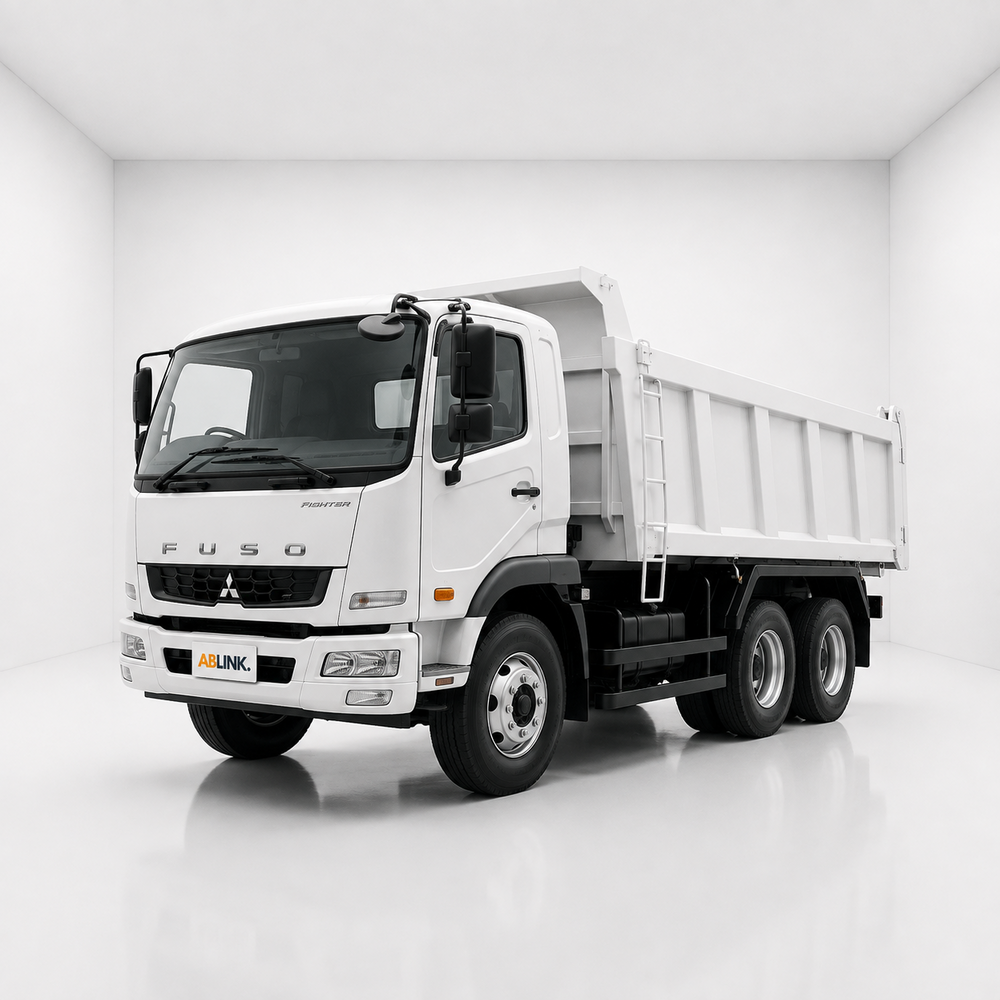
The Isuzu FVR90 is a 24ft rigid lorry rated up to 17,000 kg gross vehicle weight, powered by a 7.8-litre 6HK1 turbo-diesel engine. ABLINK lists it at S$95,800 body price, excluding COE. It sits at the top of the 24ft rigid class, above the 6-ton FRR90 and alongside the Fuso Fighter FM65.
Most buyers reach this vehicle after outgrowing a 14ft platform. However, the step up changes three things at once: your licence requirement, your COE bracket, and where the vehicle can physically load. This guide works through each in order, using ABLINK's own listed specifications and Singapore's current regulatory framework.
What exactly is the Isuzu FVR90?
The FVR90 is a rigid heavy goods vehicle with a 24-foot cargo deck and a maximum 17,000 kg GVW, according to ABLINK's product listing. Rigid means the cab and cargo deck sit on one chassis. Therefore it is not a prime mover, and it does not pull a detachable trailer.
Isuzu's F-Series covers three payload tiers in Singapore. ABLINK stocks the 6-ton FRR90 and the 10-ton FVR90 as dedicated listings. The 7-ton FSR90 appears in Isuzu's global F-Series range, but ABLINK does not currently list it as a separate product page — confirm availability directly.
Which engine does the FVR90 use, and why does it matter?
The FVR90 runs Isuzu's 6HK1 engine, a 7.8-litre turbo-diesel unit. ABLINK's listing cites high torque output and fuel efficiency as its two selling points. For fleet operators, displacement matters for fuel and power, not road tax: goods vehicle road tax is banded by maximum laden weight and fuel (LTA).
Exact power and torque figures are not published on the listing. Consequently, request the specification sheet before you compare it against the Fuso FM65.
What does S$95,800 actually include?
S$95,800 is the vehicle body price. It excludes the Certificate of Entitlement entirely. ABLINK's listing separates the two explicitly, showing "Vehicle Body Price" alongside a separate "Enquire COE Package Price" option. Treat these as two distinct line items in your budget.
A 24ft rigid lorry registers under COE Category C, which covers goods vehicles and buses. Category C premiums move every two weeks across two bidding exercises per month. As a result, no article can state a current premium accurately. Check the prevailing figure on LTA's OneMotoring bidding results before you commit.
Read ABLINK's COE Category C guide for 2026 premiums, PQP and renewal timing for the full cost framework.
Which driving licence does the FVR90 require?
Singapore assigns goods-vehicle licence classes by unladen weight, not by payload rating or gross vehicle weight. Under Rule 19(e)(ii) of the Road Traffic (Motor Vehicles, Driving Licences) Rules, Class 3 and Class 3A holders may operate light goods vehicles and small buses with unladen weight not exceeding 2,500 kg. Above that threshold, a Class 4 or Class 4P licence applies, according to the Singapore Police Force statement on revised licence requirements.
The FVR90 needs Class 4, not Class 5 — and here is why
Many buyers assume a 17,000 kg vehicle must require Class 5. It does not. Class 5 covers locomotives — heavy motor vehicles not constructed to carry any load — with unladen weight above 7,250 kg. That category splits into light locomotives from 7,251 kg to 11,500 kg and heavy locomotives above 11,500 kg.
The test is constructed purpose, not weight. The FVR90 is a rigid lorry with a cargo deck, so it is constructed to carry a load. Consequently it stays in Class 4 territory regardless of its 17,000 kg GVW. Prime movers and heavy road tractors carry no load themselves, which is precisely why they fall into Class 5.
Class 4P covers automatic-transmission Class 4 vehicles above 2,500 kg unladen weight. Verify the transmission type alongside the weight, because a Class 4P holder cannot legally drive a manual unit.
The registered unladen weight is not published on the product listing. Therefore, confirm it on the Vehicle Registration Certificate before you assign a driver.
Why the ULW and MLW distinction keeps catching buyers out
Two separate regulatory frameworks use two different weights. Licence class follows unladen weight. Heavy goods vehicle classification and government grant eligibility follow maximum laden weight. Consequently, a vehicle can fall into one bracket for licensing and a completely different bracket for grants or emissions banding.
Compare the class thresholds in ABLINK's Class 3 versus Class 4 licence comparison for Singapore lorry operators, and the heavier end in the Class 5 licence guide for heavy trucks in 2026.
Does the speed limiter rule apply to the FVR90?
Yes — but under the older rule, not the new one. Singapore law already required speed limiters on every goods vehicle with maximum laden weight exceeding 12,000 kg that would otherwise reach more than 60 km/h. The Traffic Police then expanded the regime to cover lorries between 3,501 kg and 12,000 kg inclusive.
The FVR90's 17,000 kg GVW sits above 12,000 kg. Therefore it falls under the pre-existing requirement, not the 2026 expansion. In practice, that means a compliant unit should already carry a limiter — this is not a new obligation you are budgeting for.
Both facts come from the Singapore Police Force speed limiter announcement. Confirm your unit's registered maximum laden weight on OneMotoring, since MLW rather than vehicle length determines the applicable provision.
ABLINK's speed limiter guide covering 2026 deadlines and installation sets out the phased timetable for the lighter band.
Where can a 24ft lorry actually load?
Access is the single most underestimated constraint on this platform. A 24ft rigid lorry with a box body clears well over three metres in total height. Standard HDB multi-storey carparks cannot accept it. Street-level industrial bays, open yards and void-deck loading zones work without issue.
Published clearance figures for HDB carparks vary between sources, so do not budget against a generic number. Instead, measure the clearance at your three highest-frequency loading points before purchase. This single check has changed more purchase decisions than any specification sheet.
Which body configuration should you specify?
ABLINK lists four configurations for the FVR90: box lorry, tailgate, curtain-side and open deck. Each trades payload against protection. Body weight subtracts directly from your net payload, so the configuration decision is also a capacity decision.
| Configuration | Best suited to | Main trade-off |
|---|---|---|
| Box lorry | Parcel consolidation, retail distribution, palletised goods | Heaviest body — lowest net payload |
| Curtain-side | Side-loading with forklift access, mixed-drop routes | Less secure than a rigid box |
| Tailgate | Kerbside delivery without a loading dock | Tail-lift adds weight and maintenance |
| Open deck | Steel, aggregate, long materials, construction supply | No weather or theft protection |
Net payload is not published per configuration. Accordingly, ask ABLINK for the payload figure for the exact body you intend to order.
What safety equipment comes fitted?
ABLINK's listing specifies anti-lock braking, an exhaust brake and a reinforced chassis. The exhaust brake matters on loaded descents, because it slows the vehicle without consuming service-brake friction material. Consequently, brake pad intervals stretch on hilly or heavily loaded routes.
The listing does not mention advanced driver assistance features such as autonomous emergency braking or lane departure warning. By contrast, ABLINK's Fuso Canter listing does specify an Advanced Emergency Braking System. If ADAS matters to your insurer or your safety policy, raise it during specification.
How does the FVR90 compare to its siblings?
ABLINK's 24ft range spans three payload tiers across two manufacturers. This is dealer-floor fact, not a brochure claim — each tier exists as a separate live listing with its own price.
| Model | Payload tier | Typical work |
|---|---|---|
| Isuzu FRR90 | 6-ton | General distribution, mid-weight building materials |
| Fuso Fighter FK62 | 7-ton | Denser loads needing margin above 6-ton |
| Isuzu FVR90 | 10-ton | Aggregate, full-pallet bulk, high-volume haulage |
| Fuso Fighter FM65 | 10-ton | Direct FVR90 alternative on the same tier |
Note the tier labels describe usable payload class, not GVW. For the class-level decision, read ABLINK's 24ft lorry buyer's guide covering the 6-ton to 10-ton tiers and the wider medium-duty truck comparison across Isuzu and Fuso platforms.
Should you specify 10-ton, or is 7-ton enough?
Specify by your heaviest regular load, never by your average load. Averages hide the trips that overload you. If more than a handful of runs each month approach your ceiling, the higher tier pays for itself in avoided second trips and avoided enforcement risk.
Conversely, a consistently under-loaded 10-ton platform burns fuel and COE on capacity you never use. Additionally, the larger unit narrows your driver pool and your loading-point options. The economics only favour the step up when utilisation genuinely justifies it.
What ongoing costs should you model?
Four cost lines dominate a heavy rigid over its COE term. First, road tax, which scales with maximum laden weight for goods vehicles. Second, diesel, which scales with load and route. Third, insurance, which reflects GVW and declared use. Fourth, maintenance, which concentrates on brakes, tyres and suspension on loaded work.
Model these against cost per tonne delivered, not cost per kilometre. A 10-ton platform running near capacity often produces a lower cost per tonne than a smaller lorry making two trips. Verify each figure against live quotes rather than published averages.
Should you buy new or used at the 10-ton tier?
At S$95,800 body price plus a Category C premium, a new FVR90 represents serious capital. A used 10-ton rigid costs materially less upfront. However, the comparison only works once you convert both to cost per remaining year of COE life.
A new unit carries a fresh ten-year COE and a full manufacturer warranty. A used unit with five years remaining must earn its purchase price in five years. Consequently, the cheaper vehicle sometimes carries the higher annual cost. Run that division before you compare sticker prices.
Heavy rigids also age differently from light commercials. Chassis, suspension and brakes absorb the load history of every previous operator. Therefore, service documentation matters more at 10-ton than at 14ft. Demand authorised-workshop records, not a verbal assurance.
New suits operators where downtime halts revenue directly, such as scheduled construction supply. Used suits overflow capacity and project-length contracts. Browse ABLINK's marketplace listings for used commercial vehicles if a shorter COE term fits your contract horizon.
Pre-purchase verification checklist
Eight figures matter here that ABLINK's listing does not publish. Rather than guess at them, this guide names them. Work through the list with the salesperson and every gap closes before you commit capital.
- Registered unladen weight on the Vehicle Registration Certificate — this fixes Class 4 versus Class 4P
- Registered maximum laden weight against the 17,000 kg GVW rating
- Which speed limiter provision applies, and whether a valid limiter is already fitted and certified
- Net payload for your exact body configuration, not the bare chassis figure
- Engine power and torque output, plus the Euro emission standard
- Annual road tax for the registered maximum laden weight
- Current body price, with the COE package price quoted separately
- Measured clearance and turning radius at your loading and yard entry points
Item eight defeats more heavy-rigid purchases than any specification. A 24ft rigid needs both vertical clearance and a turning circle. Measure the entry, not just the bay.
Does any emissions scheme apply to a 10-ton lorry?
No — and this is where heavy-vehicle buyers waste the most time. The Commercial Vehicle Emissions Scheme applies only to light commercial vehicles: light goods vehicles, goods-cum-passenger vehicles and small buses, all with maximum laden weight not exceeding 3,500 kg. That figure comes from the LTA and NEA joint news release of 30 December 2024.
At 17,000 kg GVW, the FVR90 is nowhere near that ceiling. Therefore no CVES band, no CVES rebate and no CVES surcharge attaches to it. Buyers who budget for a Band A incentive on a 24ft lorry have misread the scheme.
The Early Turnover Scheme did cover heavy commercial vehicles above 3,500 kg maximum laden weight. However, LTA confirmed in the same release that the ETS for heavy commercial vehicles was extended only to 31 December 2025 and ceases thereafter. Zero-emission heavy vehicles fall under separate arrangements — confirm current heavy-vehicle schemes with LTA and NEA directly before you model any incentive.
How the FVR90 fits a growing fleet
ABLINK's 24ft range spans four listings across two manufacturers and three payload tiers. That structure exists because operators rarely jump straight from 14ft to 10-ton. Most step through the 6-ton or 7-ton tier first, then upgrade once utilisation data justifies it.
Use your own load records to decide. Count the runs over the past three months that hit your current ceiling. If that count exceeds roughly a third of your trips, the next tier earns its place. Below that, you are buying capacity you will not sell.
Frequently asked questions
Is the Isuzu FVR90 currently available in Singapore?
ABLINK's product listing shows the FVR90 as in stock at S$95,800 body price, excluding COE. Stock status and pricing change, so confirm both directly before you plan a registration date.
Do I need a Class 4 or Class 5 licence for an FVR90?
Class 4, not Class 5. Class 5 covers locomotives not constructed to carry a load, such as prime movers, with unladen weight above 7,250 kg. The FVR90 carries a load on its own deck, so it remains a Class 4 vehicle despite its 17,000 kg GVW.
Can an FVR90 enter an HDB multi-storey carpark?
No. A 24ft rigid lorry with a box body exceeds standard multi-storey carpark clearance. Plan for street-level bays, open yards or void-deck loading instead, and measure your own loading points before purchase.
Does the FVR90 qualify for any emissions incentive?
No. The Commercial Vehicle Emissions Scheme applies only to light commercial vehicles with maximum laden weight not exceeding 3,500 kg, per LTA and NEA. At 17,000 kg GVW the FVR90 sits far outside that scope, so neither a CVES rebate nor a CVES surcharge applies to it.
What is the difference between the FVR90 and the FRR90?
Both are Isuzu F-Series 24ft rigid lorries. The FRR90 sits in the 6-ton payload tier; the FVR90 sits in the 10-ton tier with a larger 7.8-litre 6HK1 engine and a 17,000 kg GVW rating.
Is the FVR90 a prime mover?
No. The FVR90 is a rigid lorry with a fixed 24ft deck on a single chassis. Prime movers pull detachable trailers, register differently, and generally require a Class 5 licence.
Check current FVR90 pricing and specification
ABLINK lists the Isuzu FVR90 alongside the full 24ft range, with body price shown separately from COE. Request the specification sheet, the registered unladen weight and the net payload for your intended body configuration before you budget.
View ABLINK's new commercial vehicle range and request FVR90 pricing
Disclaimer. Vehicle prices quoted are body prices and exclude the Certificate of Entitlement unless expressly stated. COE premiums are set by open bidding and change every bidding exercise. Specifications, stock status and pricing are indicative and subject to change without notice — confirm all figures with ABLINK before purchase. Where this article states that a figure is not published, that figure remains unconfirmed and must be validated against the Vehicle Registration Certificate, the manufacturer specification sheet, or the relevant authority before you rely on it. Licence class, speed limiter obligations, CVES banding and HVZES eligibility are determined by LTA, the Singapore Police Force and NEA respectively, not by any dealer or publisher. Nothing here constitutes financial, legal or professional advice. Conduct your own due diligence before purchasing.
Written by SingRank Singapore for AB Link Pte Ltd. SEO, AEO and GEO strategy by SingRank.