Updated 23 September 2026 · By SingRank Singapore
Yes, construction firms in Singapore can lease a pickup truck by the month. For long-term pickup truck rental Singapore contractors can use ABLINK, which leases through its partner, Rentgo Pte. Ltd., and lists pickups as "perfect for construction and on-site operations". Before you compare monthly rates, check three things the quote won't show: unladen weight, log-card seating and goods-vehicle status.
Those three decide who can drive the pickup, who can ride in it and how your accountant treats the cost. They come from the Singapore Police Force, LTA and IRAS. None of them comes from a lease brochure. This guide sets them out in the order you'll meet them, then gives you seven questions to put to any lessor, us included.
Key takeaways
- ABLINK's commercial vehicle leasing Singapore page lists pickup trucks for construction, with short-term or long-term packages arranged through Rentgo Pte. Ltd.
- A diesel or petrol pickup stays on a Class 3 licence only up to 2,500 kg unladen weight. An electric light goods vehicle may weigh up to 3,000 kg (SPF, 2026).
- A foreign licence converted to Class 3C does not cover pickups for work. That driver needs Class 3 or 3A.
- LTA lets workers ride on a lorry deck only between lodging and workplace, under canopy, railing and speed rules. Cab seats on the log card must fill first.
- IRAS treats goods-vehicle motor expenses as deductible and S-plate car expenses as not deductible, even for business use.
Where can you lease a pickup for construction work in Singapore?
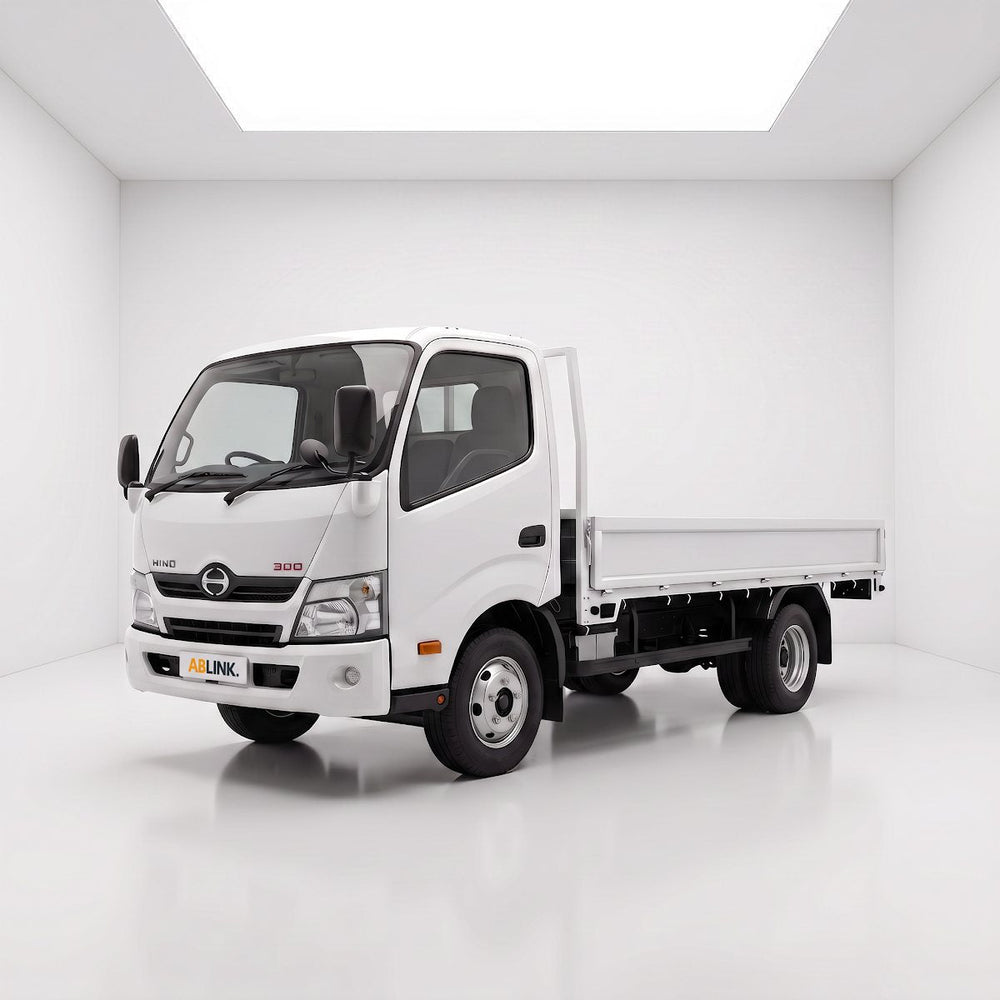
You can lease one from a commercial vehicle leasing company, not a car rental desk. A pickup here is a goods vehicle. At ABLINK the service runs with a named partner: the lease page states "Our leasing partner Rentgo Pte. Ltd." and lists four vehicle types, one of them "Pickup Trucks – Perfect for construction and on-site operations".
The same page names "Construction and renovation businesses" among the firms its plans suit. It offers short-term or long-term lease packages. It also says every vehicle is "regularly serviced, insured, and road-ready".
Bought or leased, every pick up truck Singapore contractors run faces the same Monday. A four-man crew, a generator, two ladders and a pallet of tiles need to reach a site in Tuas before 8am.
A pickup handles that job well. But only if the driver's licence covers it and the crew sits where the law allows. Get either wrong and the monthly saving vanishes at the first roadblock.
If you need a larger deck than a pickup offers, our monthly lorry rental compared with leasing guide covers 10ft and 14ft options, and our 10ft lorry guide covers specs and licence. Renovation firms weighing a van instead can read choosing a van or lorry for a renovation firm.
What does a pickup lease cover, and what is left to your quote?
ABLINK's lease page covers servicing, insurance and road-readiness in general terms, and promises no hidden fees or balloon payments. It publishes no tenure, rate, deposit or mileage figure for pickups. Those belong in your written quote, and we'd rather tell you that now than have you assume them.
| Item | What the lease page states | What to get in writing |
|---|---|---|
| Partner | Rentgo Pte. Ltd. | Which company signs the agreement with you |
| Term | Short-term or long-term packages | Exact tenure and early-exit terms |
| Upfront cost | "no large downpayments" | Any deposit or advance rental, in figures |
| Pricing | No hidden fees or balloon payments | The full monthly figure and what it excludes |
| Servicing and insurance | Regularly serviced, insured, road-ready | Insurance excess, who may drive, workshop downtime |
| Vehicle | "Pickup Trucks" (no models named) | Model, unladen weight, log-card seating |
Two lines on that list matter more than the rest for a construction firm. The model's unladen weight tells you which drivers can take it. The log-card seating tells you how many workers can ride legally. Neither appears in a monthly rate.
The page also says leasing removes depreciation worries and allows fleet upgrades "anytime". For a contractor whose headcount swings with each tender, that flexibility is the real reason to lease.
Is a pickup truck a goods vehicle in Singapore?
Yes. Every pickup truck Singapore businesses lease or buy is registered as a goods vehicle, not a private car, and that single fact drives its licence, tax and seating rules. The Singapore Police Force names pick-ups, alongside vans, as light goods vehicles that need a Class 3 or 3A licence for work.
LTA sorts goods vehicles by maximum laden weight (MLW). A light goods vehicle (LGV) carries an MLW of up to 3,500 kg, and OneMotoring's commercial vehicle page sets no special driving restrictions for LGVs. Heavier goods vehicles bring extra rules; parking a heavy goods vehicle over 5,000 kg MLW, for example, needs a Vehicle Parking Certificate.
For registration, OneMotoring's tax structure lists a light goods vehicle under COE Category C or E, with an Additional Registration Fee of 5% of Open Market Value (OMV) and excise duty exempted (LTA, 2026). Every registered goods vehicle has a 20-year lifespan.
One classification trips up double-cab buyers. OneMotoring defines goods-cum-passengers vehicles (GPVs) as vehicles that carry both cargo and people, with an MLW up to 5,000 kg. Its examples include the "twin-cabin goods vehicle" (LTA, 2026).
So a double-cab pickup may sit on the log card as an LGV or as a GPV. Ask which one before you sign, because the class sets the tax table and the carrying rules that follow.
Can your drivers take a leased pickup on a Class 3 licence?
Usually, if the pickup is light enough. Class 3 covers diesel and petrol goods vehicles whose unladen weight does not exceed 2,500 kg. For electric light goods vehicles, the Class 3 ceiling rises to 3,000 kg unladen, per the Singapore Police Force licence page updated 15 June 2026.
Above those limits you are into Class 4 territory. The same page puts any load- or passenger-carrying vehicle above 2,500 kg unladen into Class 4. A 4x4 double-cab loaded with a hard lid, a rack and a toolbox still goes by the unladen weight on its log card, so read that number rather than guessing from the brochure.
The trap for construction firms is the foreign licence. A driver who converts an overseas licence receives Class 3C, and SPF says that class lets them drive only motor cars. Before they can drive vans and pick-ups for work, they need Class 3 or 3A, which means sitting the practical test as well as the theory test.
Our advice is blunt. Don't hand a leased pickup to a supervisor on Class 3C, however experienced he is. Check each driver's class on the licence card before the vehicle arrives. For the full picture, see what a Class 3 licence covers against Class 4.
Can your workers ride in a leased pickup?
Your workers can ride in the cab up to the seats on the log card. Riding on the open deck is where the law gets strict. OneMotoring bars lorries from carrying passengers, with one exception: workers travelling between their lodging and their workplace, and only when a list of conditions is met.
Here is that list, from LTA's commercial vehicle page:
- Top speed is 60 km/h, or the road limit if that is lower.
- Side railings must be at least 700mm above the carriage deck and at least 300mm above the top of the side boards.
- A canopy is required. For light lorries, its height may not exceed 1.35 times the cabin height, measured from the road.
- Every non-enclosed side of the canopy needs a rain cover, with at least one side transparent.
- Workers sit under the canopy, with no part of any seated worker higher than 1.1m above the deck.
- Each seated worker needs the minimum deck space of 0.372 m² (4 square feet), and loose goods reduce that count.
- A Maximum Passenger Capacity (MPC) label goes on the right side of the rear tailboard.
One condition comes before all of them. Every cab seat listed on the log card must be filled before a single worker rides on the rear deck (LTA, 2026).
LTA writes these rules for lorries, and a pickup's bed is far smaller than a lorry deck. Our reading, and it is our judgement rather than LTA wording: a standard pickup bed without canopy, raised railings and rain covers cannot meet this list. Plan your crew around the cab. If you ever intend to seat anyone behind it, confirm with LTA first.
That is why we'd pick a double-cab over a single-cab for almost every construction lease. The second row is the legal space for your crew. The bed carries tools, strapped down so they cannot endanger the crew or other road users, as LTA requires.
Breaches cost more than a fine. For breaking the worker-transport safety rules, LTA and the Traffic Police can issue fines and demerit points. Employers also answer to MOM, which requires a vehicle buddy for lorries carrying workers in the rear deck, and at least 30 minutes' rest for dual-role drivers who have worked six hours on site before they drive (LTA, MOM and SPF, 2022).
What changes on 1 January 2027 for crews carried in goods vehicles?
From 1 January 2027, workers may no longer ride in caged lorry decks. The joint MOT-LTA release of 4 March 2026 announced the ban on carrying workers in caged decks from that date (MOT and LTA, 2026).
The reason is escape. LTA says a cage gate latched or locked from the outside could trap workers in an emergency.
Caged vehicles stay legal for goods. Owners may also convert the rear deck "to incorporate a canopy and side railings". Firms that fail to comply "will be subjected to penalties", with details still to come.
"My feeling is that they're like animals in a cage." — a lorry driver with more than 30 years' experience, quoted by The Online Citizen, March 2026
For a firm leasing now, the ban is a reason to check the deck before you sign. Say your lease on a caged vehicle runs past 31 December 2026. From the first day of 2027, you lose the right to carry workers on that deck.
If workers will ever ride behind the cab, ask for a cage-free deck that already has the canopy, railings, rain covers and MPC label LTA requires. A bare pickup bed does not qualify. Our caged lorry ban and worker transport rules guide walks through conversion.
Which pickup suits a construction crew, diesel 4x4 or electric?
Choose by crew size first, then by site and charging. ABLINK's new-vehicle range listed four double-cab pickups on 23 September 2026: the Toyota Hilux D-Cab 4x4 and Isuzu D-Max D-Cab 4x4 on diesel, plus the KGM Musso 2WD D-Cab and Riddara 4WD Econ. The live feed lists the Musso and Riddara as electric.
| Your job | Pickup type to ask for | Why |
|---|---|---|
| Muddy sites, towing, land clearing | Diesel 4x4 double-cab | Traction and fast refuelling anywhere |
| Tarmac jobs, fixed daily route, depot power | Electric double-cab | Class 3 ceiling of 3,000 kg unladen for electric LGVs |
| Crew of two, bulky materials | Pickup with the longest bed offered, or a 10ft lorry | A double-cab gives up bed length for seats |
| Crew of four or more plus tools | Double cab pick up plus a second vehicle | Cab seats are the legal limit for a bare bed |
The electric point deserves care. The 3,000 kg Class 3 allowance applies only to electric light goods vehicles, so a heavy electric pickup can still stay on Class 3 where a diesel of the same weight could not. Confirm the exact unladen weight on the log card of the unit you are offered.
The lease page names "Pickup Trucks" without listing models, so ask which of these models Rentgo can supply before you set your heart on one. To compare the four side by side, read four double-cab pickups compared, or browse ABLINK's new pickup truck range for the latest price and specification.
Is a leased pickup tax-deductible, unlike an S-plate car?
IRAS draws a hard line between goods vehicles and cars. Its guidance lets businesses deduct motor vehicle expenses on goods and commercial vehicles, naming vans, lorries and buses. It gives repairs, maintenance, parking fees and petrol as examples (IRAS, 2026).
Cars sit on the other side of that line. IRAS allows no deduction on motor vehicle expenses for S-plated private cars, even when they are used for business. Hiring a private car, and running or maintaining a hired one, is not deductible either, unless your company hires out cars or teaches driving.
That contrast is one honest reason a contractor chooses a pickup over an SUV. IRAS does not name lease payments on goods vehicles in that passage, so don't assume the whole monthly figure is deductible. Ask your accountant how to book it. Our what you can claim on a van or lorry guide covers the owner's side.
Road tax follows the goods-vehicle table too. OneMotoring sets light goods vehicle road tax by maximum laden weight, not engine size.
For MLW up to 3.5 tonnes, the 6-monthly road tax is S$213 for diesel and S$170 for petrol. An electric LGV pays a S$170 base plus a S$95 Additional Flat Component every six months. Ask whether road tax sits inside your lease rate.
Pickup truck rental Singapore: lease, rent or buy?
Lease when the job runs for months and you want servicing and insurance handled. Rent when it runs for days or weeks. Buy when you'll keep the pickup for years and want it on your own books. The table sets out how we'd call it for a construction firm.
| Situation | Our call | Reason |
|---|---|---|
| One project of a few weeks | Rent | No commitment beyond the job |
| A contract of several months, crew size may change | Lease | Short-term or long-term packages, fleet upgrades as you grow |
| Steady work for years, own yard | Buy | The 20-year goods-vehicle lifespan rewards long use |
| Capital tied up in tenders and materials | Lease | "no large downpayments" on ABLINK's lease page |
We'd skip buying for a firm that isn't sure the work will last past one contract. We'd skip short rental for a crew that needs the same vehicle every day for six months, because re-booking wastes the supervisor's time. Neither call is about price; each is about how long the need lasts.
Firms that rent commercial vehicle capacity by the week can start with monthly and long-term van rental, and firms that lease lorry and pickup fleets together can compare terms there too. We compare all three routes in renting, leasing or buying a van compared. If buying wins, our pickup models and costs if you would rather buy guide is the next stop, with commercial vehicle financing in Singapore alongside it.
Seven questions to ask before you sign a pickup lease
Take this list to any lessor, including us. Each answer should come back in writing, because a verbal promise won't help you at a Traffic Police check.
- Which exact model will I get, and what is its unladen weight on the log card?
- Is it registered as a light goods vehicle or a goods-cum-passengers vehicle, and how many seats does the log card show?
- Does the deck have a cage, a canopy, railings or rain covers, and will it be cage-free before 1 January 2027?
- What tenure, deposit or advance rental, and early-exit terms apply?
- What does the insurance cover, what is the excess, and which drivers are named?
- Is road tax inside the monthly figure, and who handles servicing and workshop downtime?
- Who is the registered owner, and who receives any summons or fines notice?
Question 7 sounds dull until the first speeding notice lands. A contractor who knows the answer can move fast; one who doesn't loses a week chasing paperwork.
How to request a pickup lease quote from ABLINK
Send us three facts and the quote can be specific from the first reply: your crew size, what you carry each day and your drivers' licence classes. The team will prepare a customised leasing quote with our partner Rentgo Pte. Ltd. Ask for it to name the model, its unladen weight and its log-card seating.
Request it on our pickup truck leasing Singapore page. If you'd like cover for a pickup you already own, see commercial vehicle insurance.
Frequently asked questions
How much does pickup truck rental Singapore cost per month?
ABLINK does not publish a pickup lease rate. Each quote depends on the model, tenure and inclusions. The lease page promises no hidden fees, no balloon payments and no large downpayments. Ask for the full monthly figure plus any deposit in writing, and compare quotes on the same model and term.
What is a pickup truck in Singapore's vehicle classes?
A pickup truck is a goods vehicle with an open cargo bed behind the cab. In Singapore it registers as a light goods vehicle when its maximum laden weight is 3,500 kg or less. A double-cab may be registered as a goods-cum-passengers vehicle. OneMotoring illustrates that class with the twin-cabin goods vehicle.
Can a Class 3C licence holder drive a leased pickup for work?
No. The Singapore Police Force says a converted foreign licence becomes Class 3C, which covers motor cars only. Driving vans and pick-ups for work needs Class 3 or 3A, and converting takes a practical test as well as the theory test. Check every driver's licence class before the pickup arrives.
Can workers sit in the back of a pickup in Singapore?
Only under LTA's worker-transport rules, which are written for lorries. They require cab seats to fill first, a canopy with rain covers, railings at least 700mm high, seating within 1.1m of the deck, 0.372 m² per worker and a 60 km/h cap. A bare pickup bed does not meet them.
Is a pickup better than an S-plate SUV for a contractor?
For business use, usually yes. IRAS allows deductions on motor vehicle expenses for goods vehicles such as vans and lorries, but not for S-plated private cars, even when used for business. Confirm your own treatment with your accountant.
Which insurers cover pickup trucks for construction firms?
ABLINK's leased vehicles come insured, per its lease page, so ask for the policy terms and excess in your quote. If you own your pickup, ABLINK acts as an authorised agent for both LONPAC and Tokio Marine, and can quote, renew or switch commercial vehicle cover. Tell the insurer exactly how the pickup is used.
Disclaimer: This pickup truck rental Singapore guide is general information, not legal, tax or financial advice. Leasing at ABLINK is arranged with our leasing partner, Rentgo Pte. Ltd.; tenures, deposits, inclusions and early-exit terms are set in each agreement and are not an offer.
Licence classes, worker-transport rules, road tax and tax treatment are set by the Singapore Police Force, LTA, MOM and IRAS, and can change. Vehicle prices are quoted separately from COE. Please confirm current rules with the agency concerned and current terms with the ABLINK team before you commit.