Updated 23 September 2026 · By SingRank Singapore
To switch diesel vans to electric in Singapore without wasting grant money, replace them in the order their COEs expire, and register each electric van by 31 March 2027 to collect the S$15k CVES grant. Charge the vans overnight on AC chargers, because no LTA charger grant covers a light van depot.
If you run five diesel vans, this year has been noisy. Licence rules for electric vans changed on 15 June 2026, and then, on 3 September 2026, LTA cut the heavy-vehicle grant for lighter lorries. That is two rule changes in under three months. One electric lorry distributor told The Business Times that adoption "will be reduced, possibly even quite drastically".
You still have to decide which van goes first, whether to buy or lease, and how many chargers to install. This plan answers those questions from LTA, NEA, OneMotoring and Traffic Police documents, checked on 23 September 2026. It gives no prices, just an order of work you can start this month.
Key takeaways
- The CVES grant for an electric light goods van is S$15k, paid once to the registered owner. It covers vans registered between 1 April 2025 and 31 March 2027 (CVES terms, LTA/NEA).
- A new diesel van now carries a S$20k Band C surcharge at registration.
- The Early Turnover Scheme has ended for light and heavy commercial vehicles.
- No LTA charger grant covers a light-van depot.
- Since 15 June 2026, a Class 3 driver may take any electric light goods vehicle weighing 3,000kg or less unladen.
What does it take to switch diesel vans to electric in 2026?
Moving a small fleet from diesel to electric commercial vehicles in Singapore involves four decisions: the replacement order, the buy-or-lease mix, the charger plan and the driver check. Grants reward registration dates, so order matters more than model, and the switch will span several COE expiry dates.
The stake is a date. Register a van on 31 March 2027 and it sits inside the current CVES window; register it a day later and, on the terms published so far, you lose the S$15k grant on that van.
LTA reports that electric and other zero-tailpipe vehicles made up less than 1% of new heavy vehicle registrations in 2025. By July 2026 they were around 30% (LTA, 2 September 2026). Among the lighter heavy vehicles, the share reached 55%. Those figures cover heavy vehicles; for the electric delivery van one weight class down, the grant that matters is CVES.
Browse the electric goods vans on ABLINK's new-vehicle range later; every electric goods vehicle there shows its battery and range. First decide which of your five vans is leaving, and when.
Which grants still apply to an electric van, and which have ended?
One grant still applies to a new electric light goods van: CVES Band A, worth S$15k. It covers vans with a maximum laden weight (MLW) of 3,500kg or less, registered between 1 April 2025 and 31 March 2027. It's paid once, at first registration, to the registered owner.
LTA describes Band C as "mainly diesel vehicles". The Band C surcharge rose from S$15k to S$20k when CVES was extended (LTA and NEA, 30 December 2024). OneMotoring confirms the full Band A incentive is paid, or the full Band C surcharge imposed, upon registration.
The same release set the end of the Early Turnover Scheme, which gave older diesels a discount off the Prevailing Quota Premium. See the table for the end dates.
Is one of your five really a small lorry? Above 3,500kg MLW, HVZES applies instead. It pays S$15k for a zero-tailpipe heavy vehicle up to 7,000kg MLW whose COE came from the first September 2026 bidding exercise or later, in three S$5k tranches over two years (HVZES terms, LTA).
Above 7,000kg the incentive stays at S$40k. Our guide to HVZES and the heavy-vehicle charger grant explained covers that case in full.
| Scheme | Status on 23 September 2026 | What it means for a van fleet |
|---|---|---|
| CVES Band A incentive | Live for vans registered 1 Apr 2025 to 31 Mar 2027 | S$15k per electric van, paid once to the registered owner |
| CVES Band C surcharge | Live, same window | S$20k added to a new diesel van at registration |
| Early Turnover Scheme (vans) | Ended after 31 Mar 2025 | No COE discount for scrapping an old diesel van |
| Early Turnover Scheme (heavy vehicles) | Ended after 31 Dec 2025 | No COE discount for scrapping an old diesel lorry |
| HVZES | Live to 31 Dec 2028 | Only for electric vehicles above 3,500kg MLW |
Is there a charger grant for a small van fleet?
No. Neither of LTA's two charger grants covers a depot charger for light electric vans. The EV Common Charger Grant is for shared chargers at non-landed private residences, and LTA states that industrial and commercial developments are not eligible. It also caps co-funded chargers at 22kW and runs only until 31 December 2026 (LTA charger grants page).
Fleet owners mostly hear about the Electric Heavy Vehicle Charger Grant. It co-funds up to 50% of installation cost, capped at S$30k per charger (LTA, 2026). It runs from 1 January 2026 to 31 December 2028, or until 500 chargers are approved. Its conditions rule out a van-only fleet:
- You must register a new electric heavy vehicle for each co-funded charger, and each vehicle supports one charger only.
- The charger must be rated at least 50kW and must be a smart charger.
- It has to sit at a lorry or coach lot of at least 7.5m x 3m (angled) or 9.0m x 3.0m (parallel).
- Up to three chargers per site qualify, and you install only after LTA's Letter of Offer arrives.
- LTA pays on a reimbursement basis, so you fund the work first.
So budget a light-van depot without any grant. One upside: you can pick smaller AC chargers that match your parking hours. If a lorry above 3,500kg MLW joins later, it can bring one grant-funded charger with it.
Can your Class 3 drivers drive the electric vans?
Yes, in most cases. Since 15 June 2026, Traffic Police rules let Class 3 and 3A holders drive any electric light goods vehicle whose unladen weight (ULW) is 3,000kg or less. Before that, the limit was 2,500kg (SPF, 14 June 2026).
SPF notes that electric light goods vehicles are typically 400kg to 500kg heavier than diesel ones, because of the battery. The 2,500kg line still applies to diesel and petrol vans, and above it a Class 4 or 4P licence is needed. Check each shortlisted van's ULW against 3,000kg before you order. Our explainer on what a Class 3 licence covers against Class 4 has the full table.
Which diesel van should you replace first?
Replace the van whose COE expires soonest first, if its route fits well inside an electric van's range and it parks overnight where you can charge. Replacing at expiry spends the money once, instead of renewing a diesel you plan to retire.
Rank your five vans on four tests, in order.
- COE expiry date. A van within about a year of expiry faces a renew-or-replace bill regardless. A van with years left can wait for the next wave.
- Longest day, not average day. Take the worst route of the last three months. Compare it with the van's rated range, leaving room for air-conditioning, traffic and an ageing battery.
- Where the van sleeps. A van that returns to your yard each night charges on your own charger. A van a driver takes home to an HDB car park depends on public charging, so move it last.
- Condition and mileage. Between two vans with similar COE dates, retire the one heading for an expensive repair first.
Here's an example with five made-up vans. Van A's COE expires in January 2027, and it runs a short, fixed route from base. It goes first, registered as electric before 31 March 2027.
Van B expires in May 2027 and parks at base. Replacing it now, in the same order as Van A, collects the grant; waiting for its COE to run out misses the window.
Vans C, D and E wait. One runs long routes, one sleeps at the driver's block, and one has four years of COE left.
Don't replace the newest diesel first just because it would fetch the best resale price. That leaves your oldest vans facing COE renewal bills. Replace one of them with another diesel later and you also pay the S$20k Band C surcharge, so you pay twice.
Who should hold off on switching for now?
Hold off on a van whose driver takes it home to a car park with no charger. Same for a van whose worst day runs past 489km, the longest rated range on ABLINK's live list (Maxus eDeliver 5). Hold off too if the van's only drivers hold Class 3 and the electric model you want weighs more than 3,000kg unladen. For those vans, a 5-year COE renewal buys time while the rest of the fleet goes electric.
Replace, renew, lease or wait: a decision table
This table turns the four tests into one action per van.
| Your diesel van today | Our call | Why |
|---|---|---|
| COE expires before mid-2027, short fixed route, parks at base | Replace now with an electric van, registered before 31 Mar 2027 | Collects the S$15k CVES grant and avoids renewing a van you'll retire |
| COE expires soon, but the route is long or unpredictable | Lease one electric van first as a trial | You test the route before you commit to owning the battery |
| COE expires soon and a new diesel is the only fit | Price the 5-year COE renewal against the S$20k Band C surcharge | A new diesel now carries the surcharge; renewing may buy you time |
| Driver takes the van home, no charger there | Move it last | No charger grant exists for light vans, and public charging adds driver time |
| COE has several years left, good condition | Keep and plan for a later wave | Scrapping it early earns no ETS discount now that the scheme has ended |
| Job needs more payload than a van carries | Look at an electric lorry above 3,500kg MLW | HVZES S$15k plus one EHVCG-funded charger |
For the last row, see electric 10ft lorries compared for models and weight classes.
Should you renew a diesel van's COE or replace it?
Renew the COE only on a van you plan to keep for five more years or longer. Replace it if you'd retire it sooner. A renewal is a real cost with no grant attached, and OneMotoring sets out how it's charged (OneMotoring, COE renewal).
- You can renew for 5 or 10 years. Five years costs 50% of the Prevailing Quota Premium (PQP); ten years costs the full PQP (OneMotoring, 2026).
- A Category C goods vehicle renewed for 5 years can keep renewing in 5-year periods until it reaches its 20-year statutory lifespan.
- You must renew before the COE expires, or within one month after with a late renewal fee.
A 5-year renewal suits a van for the second or third wave. It keeps a good diesel earning while your first electric van shows you what your routes really demand. If you do renew, ABLINK arranges COE renewal financing for Category C.
Buy or lease: who receives the grant?
Whoever is the registered owner collects it, under CVES and under each HVZES tranche. When you buy, that's you. When you lease, the leasing company is normally the registered owner, so the grant goes to them. Across five electric vans registered inside the CVES window, that's up to S$75k (5 x S$15k) of grant you keep or give up depending on whose name is on the log card.
That doesn't make leasing a bad deal. Just ask, in writing, whether the grant is reflected in the monthly rate.
Why lease one van instead of buying all five?
Leasing lets you trial a route without owning the battery. You can also add or return vans as work changes, which matters when a contract ends mid-year.
ABLINK leases through its partner Rentgo Pte. Ltd. with short- or long-term packages, and the vans, electric ones included, are regularly serviced, insured and road-ready. See the terms by leasing a van through ABLINK's partner.
Our pick for five vans is a mix. Buy the vans with proven, fixed routes. Lease one for the route you're least sure of, and decide at the end of the lease whether to buy.
How many chargers do five electric vans need?
Five electric vans that park at base for 10 hours or more each night usually need AC chargers, not DC. In our view, one 7kW charger per van covers a single-shift route. A 22kW charger can serve two vans in one night if someone moves the plug. That works only if each van accepts 22kW on AC, so check its spec sheet.
Divide the battery size by the charger's power to get the hours for a full charge from empty. Real charging runs slower because of losses, but most vans come back with charge left, so treat these as ceilings.
| Van (live ABLINK listing) | Battery | Hours on 7kW AC, from empty | Hours on 22kW AC, from empty |
|---|---|---|---|
| BYD eT3 | 44.9kWh | 6.4 | 2.0 |
| Citroen e-Berlingo | 50kWh | 7.1 | 2.3 |
| Maxus eDeliver 5 | 64kWh | 9.1 | 2.9 |
| Farizon V7E | 66.67kWh | 9.5 | 3.0 |
| Maxus eDeliver 7 | 77kWh | 11.0 | 3.5 |
Our arithmetic: battery kWh divided by charger kW, before charging losses and before any limit set by the van's onboard charger.
When does DC charging make sense for a van fleet?
DC charging pays off only for two shifts or a midday top-up between long runs. Don't buy DC just to feel safe. No grant covers it. Each electric listing on ABLINK's new-vehicle range lets you add one charger option to the enquiry, from AC 7kW up to DC 120kW.
Which electric vans for sale suit a delivery fleet?
Match the van's rated range to your longest day, then check payload and height. ABLINK's live new-vehicle feed lists 14 electric goods van models as of 23 September 2026. Here's a selection.
| Model | Battery | Rated range (listing) | Fits best |
|---|---|---|---|
| Foton iBlue V6 | 50.23kWh | 195km | Short, fixed town routes |
| Higer H5F | 53.58kWh | 275km | Daily depot-based delivery |
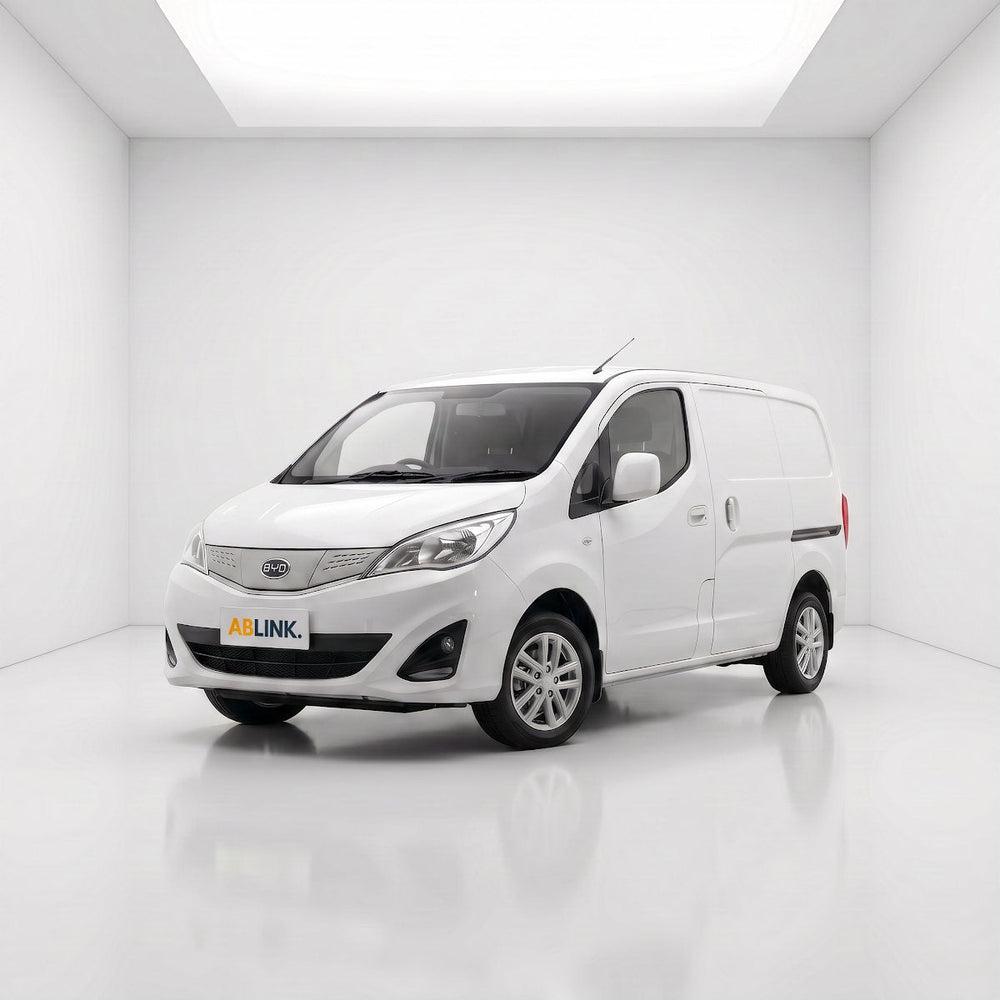
| BYD eT3 | 44.9kWh | 280km | Compact parcel and trade runs |
| Mercedes e-Vito | 60kWh | 327km | Mid-size loads, mixed routes |
| Farizon V7E | 66.67kWh | 329km | Larger loads, full-day routes |
| Citroen e-Berlingo | 50kWh | 354km | Small van, longer days |
| Opel Vivaro-e | 75kWh | 370km | Mid-size van, cross-island work |
| Maxus eDeliver 7 | 77kWh | 485km | Long or unpredictable days |
| Maxus eDeliver 5 | 64kWh | 489km | Long or unpredictable days |
Listing prices include COE and GST, not insurance. Check the latest price on each listing. For a head-to-head on two popular choices, read Maxus or BYD electric van compared. Our Maxus versus BYD eT3 running comparison and the Higer H5F review for SME fleets go deeper on single models.
Is a used electric van worth it for a later wave?
It can be, for a van in your third wave whose COE and route are both short. A used electric van is registered already, so the CVES grant was paid once, to its first owner, and nothing more is paid after that. Judge it on battery warranty left and range, not on grants. The used electric van listings on ABLINK's marketplace come from several dealers.
How do you claim the grants for an electric van?
For an electric van you don't file a separate claim. OneMotoring says the whole Band A grant is paid out at registration for vans in the current window. The grant is a cash grant from NEA through LTA to the registered owner, so the name on the registration decides who gets it.
An electric lorry above 3,500kg MLW works differently. The first HVZES tranche is used first to offset the vehicle's taxes and fees at registration, and the later tranches follow on each anniversary. The heavy-vehicle charger grant is the one you apply for, through the Government's Business Grants Portal, as set out on LTA's charger grant page.
What should you do with the diesel vans you retire?
Sell or trade them in close to the electric van's arrival. Otherwise you pay two sets of running costs for one route. ABLINK's sell page offers a free, no-obligation quotation and lists diesel and petrol vans among the vehicles it buys. Our guide to selling a van, lorry or truck step by step covers the paperwork.
Skip scrapping a healthy diesel just to be rid of it. With the Early Turnover Scheme gone, deregistering early earns no COE discount on the replacement.
What changes in road tax when a van goes electric?
Road tax on a light goods van follows maximum laden weight. Electric vans pay a usage charge on top. For a van of 3.5 tonnes MLW or less, OneMotoring lists a 6-monthly road tax of S$213 for diesel. An electric van pays a 6-monthly base road tax of S$170 plus an Additional Flat Component (AFC) of S$95 (OneMotoring, tax structure).
The AFC exists because electric vans buy no fuel. Diesel and petrol vehicles pay usage tax as Fuel Excise Duty at the pump. EVs pay theirs through the AFC. So compare the whole running bill.
LTA and NEA assess that Band A light commercial vehicles have the lowest total cost of ownership of the three CVES bands over the vehicle's lifespan. For a modelled comparison, see a five-year cost comparison of electric and diesel vans.
Where do fleet guides get the switch wrong?
Three claims still circulate online, and each can wreck a budget.
Claim one: the ECCG often part-funds a depot AC charger for vans. It doesn't. LTA excludes industrial and commercial developments outright.
Claim two: Class 3 has covered every electric van to 3,000kg unladen since December 2025. Not quite. Before 15 June 2026, only selected models were allowed under an interim exemption order. A van bought on that advice may not have qualified at the time.
Claim three still offers Early Turnover Scheme discounts. OneMotoring shows the ETS running only until 31 December 2025.
Check each one on the LTA, SPF and OneMotoring pages linked above before you sign anything that depends on a grant.
A 12-month plan to switch five vans
This plan fits five vans on single shifts from one base, starting in October 2026. The CVES window closes on 31 March 2027, so the first three months decide how much grant you keep. Adjust the months to your own COE dates.
- Week 1: list every van's COE expiry date, plate and MLW. Pull each driver's longest route from the last three months.
- Week 2: check every driver's licence class against the 3,000kg ULW rule.
- Week 3: ask your landlord or management corporation about chargers and power supply at your lots, before choosing a model.
- Month 2: shortlist two electric vans whose rated range clears your longest day with room to spare. Mark every van that passes all four tests and whose COE ends before about mid-2027. These are your grant vans. A van whose COE ends a few months after 31 March 2027 is a judgement call: replacing it early collects the grant but retires the diesel with COE still left.
- Month 2: get a purchase quote and a lease quote for each grant van. Ask each leasing company, in writing, how the CVES grant is treated, and ask for a registration date on every order.
- Month 3: order every grant van together, each with one AC charger, so all of them are registered well before 31 March 2027. On the terms published so far, a van held back for a trial and registered in April 2027 misses the S$15k grant.
- Month 3: sell or trade in the diesels they replace. Consider trading in a van for a new one, or request a free quotation for your diesel van.
- Months 4 to 6: run the new electric vans for a full quarter. Record daily distance and the charge left each morning.
- Month 6: decide the remaining vans from your own logbook, not the brochure. They fall outside the current CVES window, so lease any van whose route is still uncertain.
- Months 7 to 12: renew the COE for 5 years on any diesel you'll keep a while. Schedule the rest against their expiry dates.
- Before 31 March 2027: check OneMotoring for CVES terms after that date. Our sources set none, so don't assume the S$15k grant continues.
How to get quotes for your fleet switch
Start with the van that goes first. Shortlist the electric goods vans on ABLINK's new commercial vehicle range whose range covers your longest route, and add a charger option to the enquiry. Then ask for a lease quote on the van whose route you're least sure of.
Bring your COE dates and route list, so the quote fits your plan to switch diesel vans to electric. Every one of the electric vans Singapore operators can order new there shows its battery size and rated range.
Frequently asked questions
Do I lose the CVES grant if I lease instead of buy?
You don't receive it directly. CVES is paid once to the registered owner at first registration, and on a lease that is normally the leasing company. Ask the lessor in writing whether the grant is reflected in your monthly rate before you compare the lease with buying.
Can I still get the Early Turnover Scheme for my old diesel van?
No. The Early Turnover Scheme for light commercial vehicles ceased after 31 March 2025. For heavy commercial vehicles it ran until 31 December 2025. Scrapping an old diesel van now earns no discount on the Prevailing Quota Premium.
Does the EHVCG charger grant cover chargers for electric vans?
No. The EHVCG needs a new electric heavy vehicle registered for each charger, a charger rated at least 50kW, and a lorry or coach lot. A light electric van at 3,500kg MLW or less doesn't qualify. Nor does the ECCG help, because it excludes industrial and commercial developments.
Can a Class 3 driver drive an electric van in Singapore?
Yes, if the van's unladen weight is 3,000kg or less. From 15 June 2026 the Traffic Police allow Class 3 and 3A holders to drive all electric light goods vehicles up to that weight. Diesel vans keep the 2,500kg limit, and heavier vans need Class 4 or 4P.
What happens to CVES after 31 March 2027?
Current CVES terms cover vans registered up to 31 March 2027. None of the LTA or NEA documents we checked set terms beyond that date. Check OneMotoring before you order any van that will be registered after March 2027.
Should I switch diesel vans to electric all at once?
Not all five, but every van that qualifies. Order together each van whose COE ends before about mid-2027 and whose route and parking suit an electric van, so all register inside the CVES window. The rest follow their COE dates, once the first vans have proved your routes.
Disclaimer: This article is general information for owners planning to switch diesel vans to electric, not legal, tax or financial advice. Grant terms quoted are the CVES terms for vehicles registered between 1 April 2025 and 31 March 2027, the HVZES terms last updated 3 September 2026, and LTA's charger grant page as read on 23 September 2026.
LTA, NEA and the Traffic Police may change them at any time; confirm your own eligibility with them. Model details are from ABLINK's listings on 23 September 2026 and may change. Charging times are our arithmetic, not manufacturer figures. COE renewal financing and leases are subject to approval.